
What to Look For in a Microplastic-Free Salt
Written By Santa Prisca & Co Staff Last updated on
Every ingredient has a story, and the best ones are rooted in place and tradition. A pristine salt flat, fed by ancient springs and warmed by the Mexican sun. Here, generations of salineros have hand-harvested salt using time-honored methods that respect the rhythm of nature. This patient, artisanal process is what ensures the salt’s integrity, preserving its delicate crystals and rich mineral profile. This connection to heritage is the foundation of a vera salt microplastic free product. It’s a taste of history, craftsmanship, and a commitment to purity you can feel in every pinch.
Key Takeaways
- Purity begins with the source: A truly clean salt comes from a protected environment, like an ancient spring or pristine lagoon, and is harvested using traditional methods that preserve its natural mineral integrity.
- Be mindful of hidden contaminants: Many commercial sea salts contain microplastics from ocean pollution, so understanding where your salt comes from is essential for cooking with clean, whole ingredients.
- Verify quality with a simple checklist: To choose a pure salt, ask about its origin, look for brands that use third-party testing to confirm purity, and favor unrefined, hand-harvested options.
What Defines a Pure Sea Salt?
When we talk about pure food, what comes to mind? For me, it’s an ingredient that is exactly as nature intended, with a story you can taste. With sea salt, the word "pure" can feel a little murky. After all, isn't all salt just salt? The truth is, the journey an ingredient takes from its source to your kitchen defines its character, its flavor, and its integrity. A truly pure salt is more than just a seasoning; it’s a story of place and process, a connection to the earth that you can feel.
It begins with a pristine source, far from the pollutants that trouble our modern oceans. It continues with harvesting methods that honor tradition and preserve the salt’s natural mineral structure. This careful approach ensures that what ends up in your shaker is free from unwanted additions like microplastics and the chemical anti-caking agents found in common table salt. It’s about celebrating what’s already in the salt, a wealth of essential minerals, and appreciating what’s not. Understanding this difference is the first step toward cooking with more intention, bringing out the true flavor in your food, and nourishing your body from the inside out.
The Journey from Salt Flat to Your Table
A salt’s story always begins with its source. While many sea salts are harvested directly from the ocean, some of the world's purest salts come from more protected origins. Imagine ancient, underground springs, naturally filtered through volcanic earth, feeding a pristine, sun-drenched lagoon. This is the environment that gives birth to our Colima Sea Salt.
Because these waters are sheltered from industrial runoff and ocean-borne plastics, the salt they produce is exceptionally clean. The journey from this protected lagoon to your table is a short and gentle one. The salt is allowed to crystallize slowly under the sun, untouched by the contaminants often found in commercial sea salts. This intimate connection to a clean, terrestrial source is the foundation of its purity and its bright, mineral-rich flavor.
Why Traditional Harvesting Matters
A pristine source is only half of the story. The way salt is gathered and prepared is just as crucial to preserving its integrity. Mass-produced salts often undergo intense industrial processing, including bleaching and the addition of anti-caking agents, which strips them of their character and mineral complexity. Traditional harvesting, however, is a practice of patience and respect for the rhythm of nature.
For generations, salineros (salt farmers) have used time-honored techniques to gently rake and collect the salt by hand. This artisanal method ensures that the delicate, crystalline structure remains intact and that the salt is completely unrefined. Nothing is added, and nothing is taken away. This commitment to a natural process is why you can taste the subtle, mineral depth in every crisp flake. When you explore our salts, you’re choosing a product that honors this heritage of craftsmanship.
The Hidden Problem in Your Salt Shaker: Microplastics
It’s a quiet truth that the purity of our ingredients is deeply connected to the health of our planet. When we choose salt, we’re often looking for something natural and elemental. Yet, what’s hiding in the average salt shaker might be more than just salt. The growing issue of microplastics in our oceans has found its way into our kitchens, and it’s worth paying attention to. Understanding where your salt comes from has never been more important, not just for flavor, but for the well-being of you and your family.
How Do Microplastics Contaminate Sea Salt?
Most of the sea salt you find at the grocery store begins its life in the ocean. To harvest it, seawater is evaporated, leaving the salt crystals behind. It’s a simple, ancient process. But our modern oceans face a challenge: pollution. Tiny particles of plastic, known as microplastics, are unfortunately widespread in marine environments.
When salt is harvested from contaminated waters, these microscopic plastics can become trapped within the salt crystals. In fact, some studies suggest that the vast majority of commercial sea salts contain these unwanted additions, turning a seemingly pure ingredient into a source of hidden contaminants.
What This Means for Your Health and Wellness
The thought of plastic in our salt can be unsettling, and it’s natural to want the food we share with our loved ones to be as pure as possible. While the long-term health effects are still being studied, many of us are choosing to be more mindful about what we consume. Opting for a cleaner salt is a simple, powerful way to align your cooking with your wellness goals.
This is why seeking out a salt that is not only flavorful but also verified for its purity is so important. A truly pristine sea salt, harvested from a protected source and naturally filtered, offers peace of mind in every pinch. It’s an invitation to cook with confidence, knowing your ingredients are clean from the source to your table.
How to Verify Your Salt Is Clean
Choosing your ingredients with intention is one of the most grounding rituals we have. You read labels on packaged foods and choose organic produce when you can, so why should salt be any different? Knowing where your salt comes from and how it’s harvested is a beautiful way to deepen your connection to your food. When you seek out a pure, clean salt, you’re not just seasoning a meal; you are honoring your body and the earth.
Verifying that your salt is free from modern contaminants is a simple but powerful act of self-care. It’s about moving beyond marketing and understanding the story behind each crystal. This knowledge empowers you to make choices that align with your wellness goals and your culinary standards, ensuring every pinch adds nothing but pure flavor and beneficial minerals to your plate.
The Importance of Third-Party Lab Testing
In a world full of claims, transparency is everything. The most direct way for a company to demonstrate its commitment to purity is through independent, third-party lab testing. This process involves sending samples of the salt to an unbiased laboratory to test for contaminants like microplastics and heavy metals. It’s an honest, verifiable way to ensure the salt you’re using is truly clean.
When a brand openly shares these results, it’s a sign of deep integrity. It shows they have nothing to hide and are proud of the product they offer. We believe you should always feel empowered to ask questions about how your food is sourced and verified.
What to Look for in a Purity Report
When you look at a purity report, you are looking for confirmation of what isn't there. The primary concerns in sea salt today are microplastics and industrial pollutants, which are unfortunately common in many of our oceans. A trustworthy report will confirm the absence of these contaminants.
The salt’s origin is your first clue to its purity. Salt harvested from a protected, ancient source, far from industrial runoff, is naturally less exposed to pollutants. Our Colima Sea Salt comes from a pristine salt flat, where the water is naturally filtered through volcanic earth, adding to its mineral richness and ensuring its cleanliness long before it ever reaches a lab.
Our Commitment to Transparency
Our promise to you is simple: to provide a salt that is as pure and natural as the earth it came from. This commitment begins in the sun-drenched salt flats of Colima, Mexico, where generations of salineros have practiced the art of hand-harvesting. It’s a slow, intentional process that respects the rhythm of nature and results in a salt that is unrefined, unadulterated, and full of character.
We believe what is left out is just as important as what is inside. Our salt contains no anti-caking agents, no additives, and no microplastics. It is simply pure, mineral-rich salt, brimming with the clean flavor of its origin. We invite you to explore our collection and taste the difference that true transparency makes.
Discover the Flavor of Purity: Colima Sea Salt
When you search for a salt free from modern contaminants, you’re really searching for a taste of the past—a flavor that’s clean, honest, and deeply connected to its source. This is the essence of our Colima Sea Salt. Harvested by hand from a pristine estuary fed by the Pacific Ocean, this salt carries the story of its origin in every crystal. It’s a taste of pure sunshine and sea, untouched by the industrial processing that defines so many other salts on the shelf.
A Rich Profile of Essential Minerals
Unlike refined table salt, which is stripped down to pure sodium chloride, our Colima Sea Salt retains a beautiful spectrum of trace minerals. As the saltwater filters naturally through the volcanic earth of Colima, Mexico, it gathers essential minerals like magnesium, calcium, and potassium. These aren't just abstract elements; they are what give the salt its soul. Research on the mineral content of sea salts confirms that these natural components contribute to a food's nutritional value, adding a quiet layer of wellness to every meal you prepare. This is salt as nature intended: whole and complete.
How Natural Minerals Shape Its Gourmet Taste
That mineral complexity is what you taste on your tongue. It’s a flavor that’s balanced and round, without the harsh, one-dimensional bite of processed salts. Each crisp flake offers a burst of clean salinity that melts into a subtle, almost sweet finish. This is because the role of salt in cooking is about more than just making food salty; it’s about enhancing its inherent flavors. The minerals in Colima Sea Salt act as a quiet amplifier, making a ripe tomato taste more like itself or drawing out the earthy notes in roasted vegetables. It doesn’t overpower; it completes.
Bringing Out the Best in Your Cooking
We invite you to think of this salt not just as an ingredient, but as a final, thoughtful touch. Its delicate, flaky texture is perfect for finishing a dish, adding a visual and textural flourish right before serving. A gentle sprinkle over a grilled steak, a fresh salad, or even a dark chocolate dessert can transform the entire experience. Using high-quality finishing salts is a simple ritual that honors your ingredients and the care you put into cooking. It’s a small moment of intention that makes a noticeable difference, turning a simple meal into something truly special.
A Guide to Common Kitchen Salts
Walking down the grocery aisle can feel overwhelming with so many salt options available. Each one has a different texture, origin, and story. Understanding the journey of these common kitchen salts helps us make more intentional choices about the ingredients we bring into our homes and share with our loved ones. Let's explore a few of the most popular types and what makes them unique.
Colima Sea Salt
Our Colima Sea Salt begins its journey in the pristine waters of Cuyutlán Lagoon, a protected estuary in Mexico. Here, the salt is hand-harvested using methods passed down for generations. Because it comes from a place of such natural purity, the risk of contamination is inherently low. Research confirms that sea salts from less polluted areas tend to have lower levels of microplastics. The traditional, gentle process of sun-drying and natural filtration through volcanic earth not only preserves its incredible mineral depth but also honors the integrity of the salt, ensuring what ends up on your table is as clean as nature intended.
Himalayan Pink Salt
Himalayan Pink Salt is easily recognized by its beautiful rosy hue. It’s a rock salt mined from ancient salt deposits deep within the Himalayan mountains. Because it’s not sourced from modern oceans, it is often considered a purer choice. However, it’s not entirely immune to contamination. Some studies have found that even these ancient salts can contain trace amounts of microplastics due to broader environmental factors. When choosing Himalayan salt, it’s always wise to seek out brands that are transparent about their sourcing and testing practices to ensure you’re getting a truly clean product.
Kosher Salt
Known for its coarse, flaky texture, kosher salt is a kitchen workhorse loved by chefs. Its larger crystals make it easy to pinch and sprinkle, giving you more control over seasoning. It is typically less processed than standard table salt and contains fewer additives. While this is a plus, its purity can vary significantly from one brand to another. A global assessment of sea salt found that some kosher salts can contain microplastics, although often in lower amounts than many sea salts. The key is to look for brands that prioritize purity and are open about their production methods.
Refined Table Salt
This is the salt most of us grew up with. Refined table salt is heavily processed to remove minerals and impurities, resulting in fine, uniform crystals of pure sodium chloride. Anti-caking agents are also typically added to prevent clumping. While the intense processing can reduce the presence of some contaminants, it doesn’t eliminate the risk entirely. Studies show that microplastics can still be found in table salt. For those of us focused on whole, natural foods, the stripping of beneficial minerals and the addition of synthetic ingredients make it a less desirable choice for intentional cooking.
Your Checklist for Choosing a Microplastic-Free Salt
Choosing a pure, clean salt shouldn't feel like a research project. When you know what to look for, you can confidently select a salt that nourishes your body and honors your commitment to clean eating. Think of this as your simple guide to finding a salt you can trust, one that brings only pure flavor and minerals to your table.
It comes down to asking a few simple but important questions about where your salt comes from and how it’s handled. A truly pure salt has a story, and a brand that values quality will be happy to share it. Use these three checkpoints to guide you on your next trip to the market or when browsing online. They will help you look past the marketing and connect with the substance of what you’re buying.
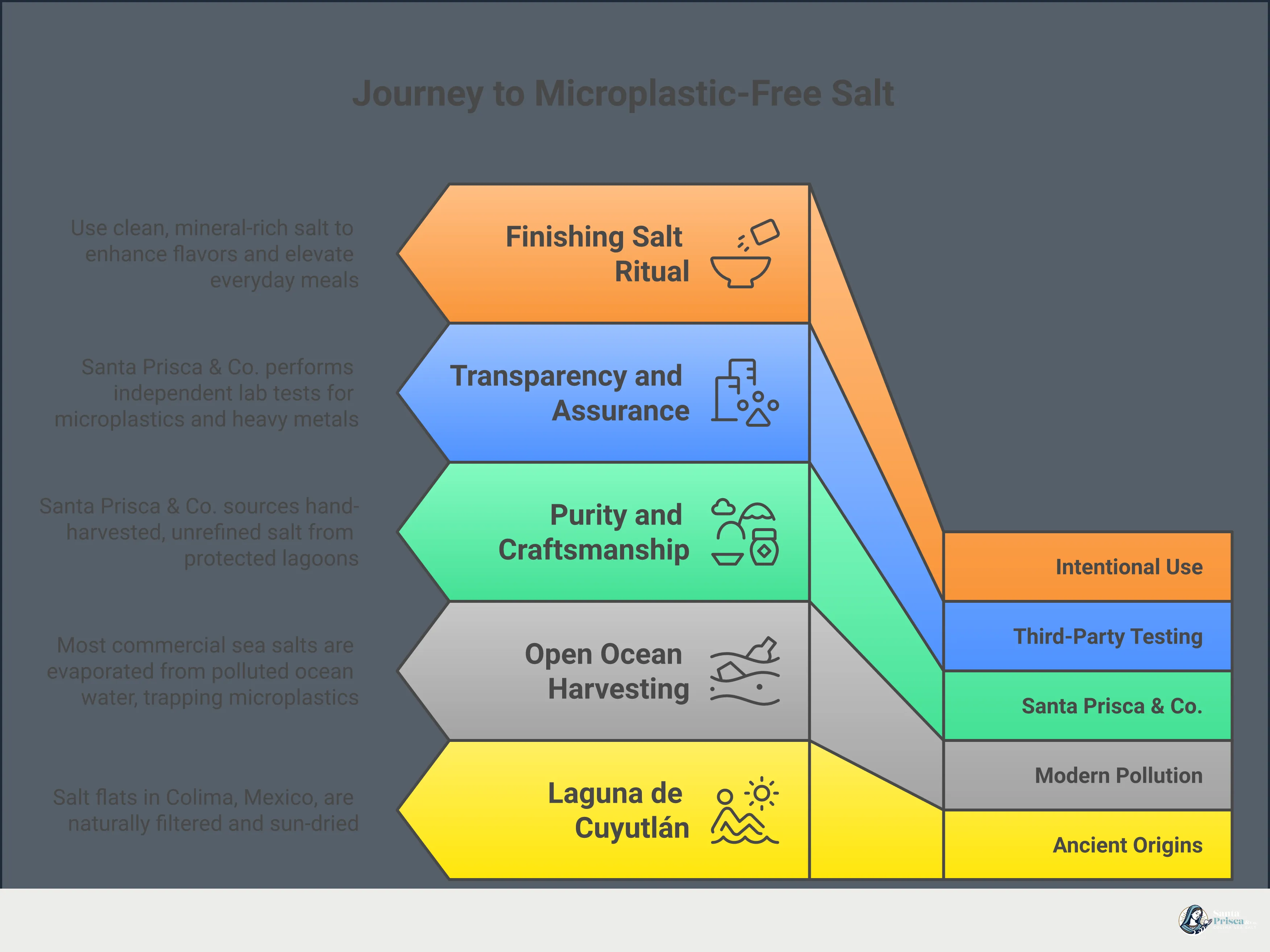
Ask About the Source
The first and most important question is about origin. Where does the salt begin its journey? Many sea salts are harvested directly from modern oceans, which unfortunately exposes them to widespread microplastic pollution. A truly clean salt often comes from a more protected source, shielded from industrial runoff and plastic waste.
For example, our Colima Sea Salt is sourced from the waters of an ancient spring deep beneath the Colima volcanoes. This water is naturally filtered through volcanic earth, emerging in a remote, pristine salt flat. This protected origin ensures the water is as pure as its source, untouched by the contaminants found in open seas.
Look for Independent Testing
A company’s commitment to purity should be something they can stand behind. While you may not see a lab report on every package, brands that are serious about quality often perform third-party testing to verify their salt is free from microplastics, heavy metals, and other contaminants. This step shows a deep respect for both the product and the person using it.
If this information isn’t readily available on a company’s website, don’t be afraid to ask. A transparent brand will welcome your questions and be open about their quality control process. You can always reach out to the company to inquire about their testing standards and commitment to purity.
Understand the Harvesting Method
How salt is gathered and prepared is just as important as its source. Industrial processing can strip salt of its natural mineral complexity and introduce additives. Look for salt that is harvested using traditional, time-honored methods that preserve its natural state.
Words like “hand-harvested” and “unrefined” are excellent indicators. This means the salt was likely gathered by skilled artisans, or salineros, who gently rake the salt crystals and allow them to dry naturally under the sun. This patient process avoids bleaching and anti-caking agents, ensuring the salt that reaches you is exactly as nature intended. When you explore our collection, you’re seeing the result of this beautiful, traditional craft.
Is Investing in Pure Salt Worth It?
When you see a bag of artisan salt next to a simple canister on the grocery store shelf, it’s natural to wonder about the difference. Is a higher price for something as fundamental as salt really justified? We believe that when you choose a pure, unrefined salt, you’re not just buying an ingredient. You’re making a meaningful investment in your food, your wellness, and the story on your plate.
The Long-Term Value of Clean Ingredients
Choosing clean ingredients is about more than just flavor; it’s about peace of mind. Many sea salts today are harvested from oceans that unfortunately contain microplastics and other pollutants. When we cook with intention, we deserve to know that every element we add to our meals is as pure as possible.
Investing in a salt that is sourced from a pristine environment and verified for its purity means you can cook with confidence. It’s a small, daily act of care for yourself and your loved ones. This commitment ensures that the beautiful mineral depth you’re adding to your food is exactly what nature intended, which is the defining quality of a truly pure salt.
Where to Find Traditionally Harvested Sea Salt
The secret to finding an exceptional salt lies in its origin story. Where does it come from, and how is it gathered? Traditionally harvested salts are often sourced from protected, ancient springs or salt flats, far from polluted waters. The methods used are typically done by hand, following techniques passed down through generations that honor both the land and the craft.
This careful, unhurried process is what separates a truly special salt from a mass-produced one. Instead of harsh, industrial processing, hand-harvesting preserves the salt’s delicate crystalline structure and rich mineral content. When you’re looking for a pure salt, seek out brands that proudly share their harvesting story. We invite you to explore our collection and discover the difference that tradition makes.
Related Articles
- Eco-Friendly Sea Salt: Good for You & the Planet
- A Buyer's Guide to Colima Sea Salt
- Sweet and Salty: The Delicate Dance of Colima Sea Salt in Dessert Dishes
- Colima High Mineral Sea Salt: Benefits & Uses
- 7 Benefits of Colima Sea Salt for Health & Flavor
Frequently Asked Questions
What really separates Colima Sea Salt from the regular table salt I grew up with? The main difference is what’s left in our salt and what’s taken out of table salt. Common table salt is heavily processed, stripping it of its natural minerals and often adding anti-caking agents. Our Colima Sea Salt is unrefined, so it retains a beautiful spectrum of trace minerals like magnesium and calcium. This not only contributes to a more complex, balanced flavor but also means you’re seasoning your food with salt in its most complete, natural state.
I've heard about microplastics in salt. How concerned should I be? It’s a valid concern, as many sea salts are harvested from modern oceans where microplastic pollution is widespread. While research on the health effects is ongoing, many of us prefer to be mindful about what we consume. Choosing a salt from a protected, pristine source that is verified for its purity offers valuable peace of mind. It’s a simple way to ensure the ingredients you share with your loved ones are as clean as possible.
How is Colima Sea Salt different from other natural salts, like Himalayan pink salt? While both are wonderful natural salts, their origins give them unique qualities. Himalayan salt is a rock salt mined from ancient land deposits. Our Colima salt is a sea salt born from a protected estuary, where the water is naturally filtered through volcanic earth before being hand-harvested under the sun. This journey gives it a distinct mineral profile and a bright, clean flavor with a delicate, flaky texture that is different from the crystalline structure of Himalayan salt.
Is this salt just for finishing dishes, or can I use it for all my cooking? You can absolutely use it for all your cooking. While its beautiful, crisp flakes are perfect for finishing a dish with a touch of texture, its clean flavor enhances everything from roasted vegetables to soups and marinades. It dissolves easily and seasons food with a balanced salinity that doesn't overpower. We love keeping a small bowl of it on the counter for both seasoning during the cooking process and for that final, thoughtful sprinkle.
How can I be sure your salt is truly pure and free from contaminants? Our commitment to purity begins at the source. Our salt comes from a protected, pristine salt flat in Colima, Mexico, where the water is naturally filtered far from industrial pollutants. To confirm what this clean origin provides, we use independent, third-party labs to test for microplastics and heavy metals. We believe you deserve to know exactly what’s in your food, and we’re proud to offer a salt that is simply clean, mineral-rich, and full of character.