
Pure Unprocessed Sea Salt 101: A Complete Guide
Written By Santa Prisca & Co Staff Last updated on
For years, we’ve been told to be wary of salt, to see it as something to limit or avoid. But what if that advice overlooks a crucial distinction? The conversation about salt changes entirely when we shift our focus from processed table salt to pure unprocessed sea salt. This isn’t about restriction; it’s about nourishment. When left in its whole, natural state, salt provides a spectrum of essential trace minerals that our bodies need for balance and hydration. This guide will help you reframe your relationship with this vital element, exploring its gentle wellness benefits and showing you how to season your food with confidence and care.
Key Takeaways
- Embrace salt as a whole food: Unrefined sea salt is simply sun-dried seawater, which preserves its natural trace minerals, while processed table salt is stripped of this complexity and often contains additives.
- Nourish your body with essential minerals: The minerals naturally present in pure sea salt, like magnesium and potassium, play a key role in supporting your body's hydration and digestive wellness.
- Season with intention and notice the difference: Look for salt with a slightly moist texture and off-white color, and use its crisp flake as a finishing touch to add a burst of clean, mineral flavor to your meals.
What is Pure, Unprocessed Sea Salt?
Have you ever stopped to think about what’s really in your salt shaker? At its heart, pure, unprocessed sea salt is simply crystallized ocean water, created in harmony with the elements. It’s harvested by allowing the sun and wind to evaporate seawater, leaving behind delicate salt crystals brimming with character.
Unlike its highly processed counterparts, this salt isn’t stripped of its complexity. It holds onto a beautiful array of more than 60 trace minerals like magnesium and potassium that are naturally present in the ocean. You won’t find any chemical bleaching agents or anti-caking additives here. What you get is pure, unadulterated salt, just as nature intended. This is the kind of salt that connects us to the earth, a simple, whole ingredient that carries the story of its origin. Our Colima Sea Salt is a perfect example, born from the pristine lagoons of Mexico and harvested with intention.
The Art of Traditional Solar Evaporation
Imagine shallow pools of seawater shimmering under the sun. The art of traditional solar evaporation is a slow, patient dance with nature. For generations, salt artisans have worked in harmony with the sun and wind, allowing them to gently kiss the water's surface and carry its moisture away.
What remains are delicate, mineral-rich crystals, hand-harvested with care. This ancient method ensures the salt’s natural structure and mineral content are preserved, creating a product that is as pure as the environment it came from. It’s a testament to the beauty of working with nature, not against it, resulting in a salt with a crisp flake and a burst of mineral depth.
Unrefined vs. Processed: What's the Real Difference?
It’s a common misconception that all salt is the same. The truth is, the journey from sea to shaker makes all the difference. Processed table salt is often superheated and chemically treated, a process that strips away its beneficial trace minerals. It’s then bleached to achieve that uniform white color and mixed with anti-caking agents to ensure it flows freely.
Unrefined sea salt, on the other hand, is left whole. It retains its natural moisture and a full spectrum of minerals, which contribute to its nuanced flavor and slightly off-white or grayish hue. Choosing unrefined is choosing a whole food over a stripped-down ingredient, one that honors the integrity of its source.
How is Sea Salt Different from Table Salt?
It’s easy to think of salt as just salt, a simple white crystal in a shaker. But when you place a pinch of pure sea salt next to common table salt, you begin to understand they are worlds apart. One is a product of heavy industrial processing, while the other is a gift from the earth, shaped by sun, wind, and water. The difference isn't just in the taste; it’s in the texture, the mineral composition, and the story of how it reached your kitchen.
Table salt is mined from underground deposits and processed at very high temperatures. This intense process strips away the naturally occurring minerals, leaving behind almost pure sodium chloride. To prevent clumping, anti-caking agents and other additives are often mixed in. The result is a uniform, fine-grained salt with a sharp, one-dimensional flavor.
Pure sea salt, on the other hand, tells a story of its origin. It’s a reflection of the sea it came from, retaining a beautiful complexity that processing erases. Understanding this distinction is the first step toward cooking with more intention and appreciating the ingredients that nourish us.
A Spectrum of Essential Minerals
The most significant difference lies in what’s left behind after harvesting. Because table salt is so heavily refined, it’s missing the trace minerals that are naturally present in seawater. Unprocessed sea salt, like our Colima Sea Salt, retains a whole spectrum of these elements, including magnesium, potassium, and calcium.
This isn't just about what’s absent from table salt, but what’s present in sea salt. These minerals contribute to a rounder, more nuanced flavor and are essential for our bodies. They play a quiet but important role in supporting functions like natural electrolyte balance and proper hydration. It’s a gentle reminder that food in its whole form often offers more than the sum of its parts.
The Journey from Sea to Shaker
The path from source to table shapes the final product. Table salt’s journey is industrial; it’s often bleached and treated to create a perfectly uniform white crystal. This method is efficient, but it sacrifices the salt’s natural character and integrity. It becomes a manufactured commodity rather than a whole food.
In contrast, the journey of a hand-harvested sea salt is one of patience and tradition. It involves allowing seawater to evaporate naturally under the sun, a slow process that lets the crystals form organically. This gentle method preserves the salt’s mineral content and unique structure. The level of processing truly matters, as it determines whether you get a stripped-down ingredient or one that remains whole and connected to its source.
How Texture and Flavor Transform Your Cooking
This is where the magic happens in the kitchen. The fine, harsh grains of table salt dissolve instantly, often leading to over-salting. Its flavor is aggressive and can easily overpower a dish.
A quality sea salt offers a completely different sensory experience. The crystals are often larger, with a delicate, flaky texture that provides a satisfying crunch when used as a finishing salt. The flavor is clean and bright, with a subtle mineral depth that enhances food without overwhelming it. A pinch of pure sea salt can draw out the sweetness of a ripe tomato or add a final, perfect touch to grilled fish. It invites you to season with intention, transforming a simple act into a moment of connection with your food.
What Are the Wellness Benefits of Unprocessed Sea Salt?
When we talk about wellness, salt is often treated like the enemy. We’re told to cut back, to watch our intake, and to be wary of its effects. But this advice usually overlooks a crucial detail: not all salt is the same. The conversation changes completely when we shift our focus from the stark white, heavily processed table salt to the beautiful, complex world of pure, unrefined sea salt. This isn’t just about seasoning your food; it’s about reconnecting with an element that is fundamental to life.
Choosing a pure, mineral-rich salt is a simple act of intention. It’s a way to honor your body and the food you prepare. Instead of just adding a generic salty taste, you’re introducing a spectrum of minerals and a depth of flavor that tells a story of its origin—the sun, the sea, and the earth. This small shift can support your body’s natural rhythms, from maintaining hydration to aiding digestion. It’s time to reframe our relationship with salt, seeing it not as a problem to be managed, but as a vital source of nourishment and a partner in our well-being. This approach invites a moment of mindfulness into the kitchen, transforming a simple pinch of salt into a gesture of gratitude for the natural elements that sustain us.
Nourish Your Body with Essential Minerals
Imagine a salt that tastes not just of saltiness, but of the ocean it came from. That’s the gift of unrefined sea salt. While table salt is stripped down to pure sodium chloride, our Colima Sea Salt holds onto a beautiful array of minerals from its journey through volcanic earth. These elements, like magnesium, potassium, and calcium, give the salt its unique, nuanced flavor and subtly moist texture. More than just enhancing taste, these are the same beneficial trace minerals our bodies need for nerve transmission, muscle function, and overall balance. Each crisp flake carries a mineral depth that processed salt simply cannot replicate, offering a more complete and nourishing way to season your food.
Find Your Balance: Supporting Natural Hydration
We all know to drink more water, but true hydration goes deeper. It’s about helping your body absorb and use that water effectively, and that’s where electrolytes are key. The essential minerals found in unrefined sea salt—like sodium, potassium, and magnesium—are natural electrolytes. They help maintain the delicate fluid balance inside and outside our cells, which is crucial for everything from nerve signals to muscle contractions. A small pinch of pure sea salt in your morning water or a thoughtfully seasoned meal can help replenish these vital minerals. By choosing salts with a natural mineral profile, you are supporting your body’s innate ability to stay hydrated and feel energized throughout the day.
A Gentle Aid for Digestion
Healthy digestion begins with intention, starting even before you take your first bite. The simple taste of salt on your tongue is one of the first signals that awakens your digestive system. It helps activate salivary enzymes and encourages your stomach to produce the hydrochloric acid needed to properly break down food and absorb its nutrients. Using a pure, unrefined sea salt is a simple way to support this beautiful, natural process. Think of it as a small kitchen ritual that honors your body’s innate wisdom. When you choose a high-quality salt, you’re making an informed dietary choice that not only adds incredible flavor but also gently assists one of your body’s most important functions.
How to Choose a Quality Sea Salt
Walking down the grocery aisle, you’ll find a dizzying array of salts. The labels can be confusing, but learning to spot true quality is simpler than you think. It’s about looking beyond the marketing and connecting with the story of the salt itself, from its color and texture to the way it was gathered. When you know what to look for, you can choose a salt that truly nourishes your body and brings a clean, mineral-rich flavor to your kitchen.
What to Look For: Signs of Authenticity
Authentic, unrefined sea salt doesn’t look like the uniform, bright white crystals you might be used to. True quality has character. Look for a subtle, pearly-grey hue, which signals the presence of trace minerals absorbed from the earth. The crystals should be irregular and varied in size, a beautiful sign that they haven’t been crushed and processed into conformity. A quality sea salt might also feel slightly moist to the touch. This is a good thing. It means the salt retains its natural brine, full of minerals that industrial drying processes would strip away. Our Colima Sea Salt is a perfect example of this beautiful, natural imperfection.
Why Hand-Harvesting Makes a Difference
The way salt is gathered has a profound impact on its final quality. Hand-harvesting is a gentle, ancient art, a patient practice of skimming delicate salt crystals from the surface of the water. This traditional method ensures the salt’s fragile mineral structure remains intact. Unlike industrial operations that use heavy machinery, hand-harvesting is a careful process that honors the salt and the people who collect it. This mindful approach preserves the full spectrum of beneficial trace minerals, offering so much more than just sodium. It’s a difference you can taste and feel good about supporting.
How to Read a Label for True Purity
Labels often use words like “natural” and “pure,” but these terms can be misleading. The real story is in the details. First, check the ingredient list. It should contain one thing: sea salt. Avoid any products with anti-caking agents, dextrose, or other additives. Next, look for information about its origin and harvest method. A company proud of its product will tell you where it comes from and how it was gathered. Knowing the source and processing method is key to understanding its flavor and mineral profile. When you choose a salt with a clear story, you’re choosing with intention.
Common Myths About Sea Salt
In the world of wellness and whole foods, it can be hard to separate fact from fiction. Salt, one of our most essential ingredients, is surrounded by its own set of misunderstandings. Let's gently clear the air and explore the truth behind some common myths, so you can season your food with confidence and intention.
Myth: All Salt Is Created Equal
It’s easy to stand in the grocery aisle and assume all salt is more or less the same. But the truth is, not all salt is created equal. The journey from its source to your kitchen makes all the difference.
Most table salt is heavily processed, stripped of the trace minerals that naturally occur alongside sodium chloride. What’s left is a sterile product. Unrefined sea salt, like our Colima Sea Salt, is simply evaporated by the sun, preserving a spectrum of minerals like magnesium and calcium. This gentle process gives it a complex flavor and a subtly moist, crystalline texture.
Myth: "Natural" Always Means Additive-Free
We’re often encouraged to look for "natural" on food labels, but this word can be misleading. Many commercial sea salts, despite being marketed as a healthier alternative, still contain anti-caking agents to prevent clumping. These additives have no place in a pure, wholesome salt.
True purity isn’t just a marketing term. When choosing a sea salt, look for labels that explicitly state "unrefined" and "additive-free." A truly pure sea salt should have only one ingredient: salt. Its slightly damp feel and irregular crystals are signs of its authentic, untouched nature.
Myth: Sea Salt is "Low Sodium"
This is one of the most persistent myths about salt. Chemically, unrefined sea salt and table salt contain similar amounts of sodium chloride by weight. The wellness benefit of switching to a pure sea salt comes from what you get in its place: a wealth of trace minerals that support your body’s balance.
The real difference is in the flavor and texture. Because unrefined sea salt has a more complex and potent flavor, you may find you need less of it to bring your food to life. The crisp, flaky structure of a hand-harvested finishing salt delivers a burst of flavor that allows you to season more thoughtfully.
The Santa Prisca & Co. Difference
Not all salt is created with the same intention. We believe the journey from the earth to your table should be one of integrity, tradition, and care. It’s about more than just flavor; it’s about honoring the hands that harvest it and the land that offers it. This connection is at the heart of everything we do, a difference you can taste in every single crystal.
Our Heritage: The Story of Colima Sea Salt
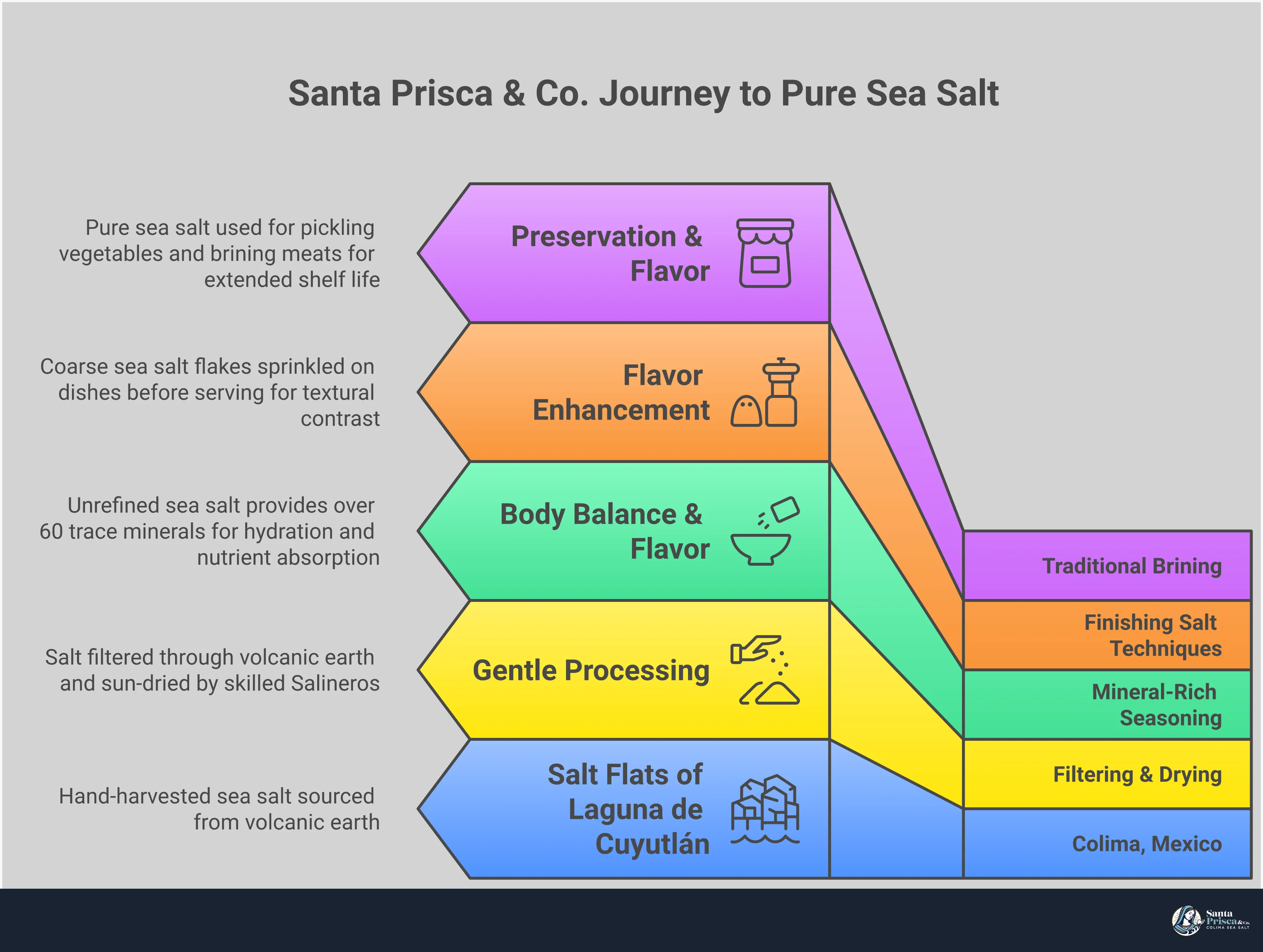
Our story begins in Colima, Mexico, home to some of the purest salt flats in the world. Here, ancient volcanoes stand guard over a pristine lagoon where our salt is born. For generations, master Salineros have practiced the art of harvesting salt by hand, a tradition passed down with reverence and skill. They understand the rhythms of the sun and the sea, working in harmony with nature to gather this gift from the earth. Each grain of our Colima Sea Salt carries this history, a taste of a place where craftsmanship and nature are beautifully intertwined.
Hand-Harvested for Unmatched Quality
Our salt is never touched by heavy machinery. Instead, it is gently gathered by hand and dried naturally under the warm sun. This patient, time-honored method ensures the salt’s delicate structure and rich mineral content remain intact. As it forms, the salt is naturally filtered through the volcanic earth below, which contributes to its unique, clean flavor and crisp texture. The result is a beautiful, unrefined flake with a burst of mineral depth that enhances food without overpowering it. This careful process is what makes our salt a true culinary staple, which you can explore in our shop.
A Promise of Purity: Always Additive-Free
What we leave out is just as important as what’s inside. You will never find anti-caking agents, bleaches, or other additives in our salt. It is 100% pure and unrefined, free from the microplastics often found in processed salts. This commitment to purity means you get a clean flavor and the full spectrum of naturally occurring minerals like magnesium, calcium, and potassium. These essential elements support the body’s natural hydration and overall wellness. It’s a simple choice that brings you closer to the source, offering a salt that truly nourishes. You can learn more in our complete Colima Sea Salt guide.
How to Use Pure Sea Salt in Your Kitchen
Bringing a pure, unrefined sea salt into your kitchen is an invitation to cook with more presence and intention. Beyond its incredible flavor, this simple ingredient can transform everyday meals into moments of nourishment and connection. Let’s explore a few simple ways to weave its magic into your cooking, from the final flourish to the foundational seasoning.
The Art of the Finishing Salt
Think of a finishing salt as the final, thoughtful touch that brings a dish to life. Unprocessed sea salt is excellent for both cooking and as a finishing salt because of its complex taste and delicate texture. A sprinkle just before serving adds a burst of clean, mineral flavor and a satisfying light crunch that engages all the senses. Imagine the crisp flake of Colima Sea Salt melting on a slice of ripe avocado, glistening atop a perfectly seared fish, or adding a surprising counterpoint to a dark chocolate tart. This simple act takes a meal from good to truly memorable, turning food into an experience.
Seasoning with Intention
Seasoning your food can be a beautiful ritual of tasting and adjusting, a quiet conversation with your ingredients. When you choose high-quality salts, you’re making an informed choice for both flavor and wellbeing. Rather than just shaking salt over a finished plate, try seasoning in layers as you cook. This allows the salt’s mineral depth to meld with the other flavors, creating a more harmonious and complex dish. Use your fingers to feel the texture of the crystals. Notice how they dissolve into a sauce or adhere to roasting vegetables. This mindful approach helps you connect more deeply with your cooking and nourish your body with intention.
Preserving the Harvest: Brining and Curing
For generations, salt has been a trusted ally in preserving the abundance of the seasons. Natural salts are ideal for these timeless methods because they retain beneficial trace minerals, offering more than just sodium to your preserved foods. Free from the additives and anti-caking agents found in common table salt, pure sea salt ensures a cleaner brine and a purer flavor in your pickles, cured meats, or brined chicken. This traditional practice of brining not only extends the life of your food but also deepens its flavor in a way that feels both grounding and nourishing, connecting you to the rhythms of nature.
Why the Source of Your Sea Salt Matters
Have you ever thought about where your salt comes from? Not just the store or the box, but the water, the earth, and the hands that gathered it. The journey of a single salt crystal from a pristine lagoon to your kitchen table is a story of place. Just as the soil and climate give wine its unique character, the environment where sea salt is born shapes its flavor, texture, and mineral gifts.
How a Pristine Environment Shapes Flavor
The taste of true sea salt is a reflection of its home. When salt forms in a clean, protected environment, it absorbs a beautiful complexity from its surroundings. Our Colima Sea Salt, for instance, is naturally filtered through ancient volcanic earth, which imparts a subtle, mineral-rich flavor that you just can’t find in processed salt.
Pure, unprocessed sea salt retains these trace elements, giving it a gentle, nuanced taste rather than a sharp, chemical bite. This is why a simple pinch can make a tomato taste more like itself or bring a quiet depth to a simple soup. It’s not just about adding saltiness; it’s about adding character.
The Significance of Traditional Salt Flats
For centuries, communities have worked in harmony with the sun, wind, and water in traditional salt flats. These are not industrial sites; they are living landscapes where salt is gently coaxed from the sea using methods passed down through generations. This patient, hands-on approach does more than preserve a way of life. It protects the salt’s delicate crystal structure and its wealth of beneficial trace minerals.
When salt is harvested by hand, there’s an element of care and intention that industrial processes simply cannot replicate. Choosing salt from these traditional flats means you are supporting the artisans who are stewards of this ancient craft, ensuring their wisdom continues to grace our tables.
Choosing Salt That Honors the Earth
Every purchase we make is a choice about the kind of world we want to live in. When you choose sea salt from a sustainable source, you are supporting practices that protect delicate coastal ecosystems and honor the earth’s natural cycles. It’s a small but meaningful way to connect your kitchen to the health of our planet.
This conscious choice extends to your own well-being. By opting for pure, unrefined salt, you are nourishing your body with an ingredient free from anti-caking agents and other additives. It’s a simple return to nature. When you explore our collection, you’re choosing a salt that is as good for the earth as it is for you.
Related Articles
- The Real Health Benefits of Unprocessed Salt – Santa Prisca & Co
- Unrefined Sea Salt: Ultimate Flavor & Health Guide – Santa Prisca & Co
- 7 Real Benefits of Hand-Harvested Sea Salt – Santa Prisca & Co
- Unrefined Sea Salt: Flavor & Wellness Guide | Santa Prisca & Co
- Raw Sea Salt Guide: Benefits, Uses, and Meaning – Santa Prisca & Co
Frequently Asked Questions
Is unrefined sea salt really better for you than table salt? While both contain similar amounts of sodium, the real difference is in what else they offer. Processed table salt is stripped of its natural minerals, leaving just sodium chloride and often, additives. Unrefined sea salt, however, retains a beautiful spectrum of trace minerals like magnesium and potassium. These elements support your body’s natural hydration and balance, making it a more complete, whole-food choice for your kitchen.
Why does my Colima Sea Salt look grey and feel a bit damp? That subtle grey hue and slight moisture are actually beautiful signs of quality and purity. Unlike processed salt that is bleached and dried at high temperatures, our salt is left in its natural state. The color comes from the rich minerals it absorbs from the volcanic earth of Colima, and the dampness means it hasn't been stripped of its natural brine. It’s salt as nature intended, free from anti-caking agents.
Can I use this salt for everything, including baking? Absolutely. Our Colima Sea Salt has a clean, bright flavor that enhances everything it touches. For cooking and baking, you can use it just as you would any other salt, though you may find you need a little less because its flavor is more complex. It truly shines as a finishing salt, where its delicate, crisp texture can add a final touch to salads, grilled vegetables, or even chocolate desserts.
Since it has more minerals, does sea salt taste different? Yes, and it’s a difference you’ll appreciate. Table salt has a sharp, one-dimensional taste that can easily overwhelm a dish. Unrefined sea salt offers a rounder, more nuanced flavor with a subtle mineral depth. It enhances the natural taste of your food instead of just making it salty. This complexity is why a simple pinch can make a ripe tomato taste sweeter or a simple soup feel more satisfying.
What does "hand-harvested" actually mean for the salt? Hand-harvesting is a traditional, patient method where artisans gently skim the salt crystals from the water's surface. This careful process avoids the use of heavy machinery that can crush the salt's delicate structure. It ensures the salt’s natural mineral profile and unique texture are preserved, resulting in a pure, high-quality product that honors both the environment and the generations of skill behind it.