
Sea Salt vs. Rock Salt: What's the Real Difference?
Written By Santa Prisca & Co Staff Last updated on
Every ingredient in your kitchen has a story. The olive oil tells a tale of sun-drenched groves, and the flour speaks of golden fields. Even the humble salt crystal has a powerful origin story that defines its character. This is especially true when you consider the two most common types. So, what is the difference between sea salt and rock salt? One is a gift from the living ocean, created by the sun and wind in a patient, natural process. The other is a relic of ancient seas, mined from deep within the earth. Their paths from source to shaker are completely different, and that journey shapes their flavor, texture, and mineral content in profound ways.
Key Takeaways
- Understand the source: Sea salt comes from evaporated seawater, a gentle process that preserves its natural trace minerals and complex flavor. Rock salt is mined from ancient deposits and heavily refined, stripping away its mineral content and often adding anti-caking agents.
- Use the right salt for the job: Reach for unrefined sea salt as a finishing touch to add a delicate crunch and nuanced, mineral-rich flavor to your meals. Reserve coarse rock salt for functional tasks like creating a salt crust or making ice cream, where a sharp, direct saltiness is all that's needed.
- Choose a more nourishing option: By opting for unrefined sea salt, you are choosing a whole food with a full spectrum of minerals that support hydration and digestion. It’s a simple way to season with intention, avoiding the additives found in processed table salt.
Sea Salt vs. Rock Salt: What’s the Real Difference?
Walking down the grocery aisle, you’ll see countless types of salt. It’s easy to assume they’re all the same, but the difference between them is as vast as the land and sea. The story of a salt begins with its source, which shapes its texture, flavor, and how it nourishes our bodies. Understanding this distinction is the first step toward cooking with more intention.
Let's explore two of the most common types: sea salt and rock salt. While they both come from saltwater, their journeys to your kitchen are worlds apart. One is gently harvested from living oceans, while the other is mined from ancient, subterranean beds. This fundamental difference in origin and processing changes everything, from the way the salt tastes to the minerals it contains.
Sea Salt: A Gift from the Ocean
Sea salt is a direct gift from the ocean, born from the sun and wind. It’s produced by evaporating modern seawater, a gentle process that allows delicate, flaky crystals to form. This careful harvesting preserves a complex flavor that can’t be replicated.
Unlike heavily processed salts, unrefined sea salt retains its full spectrum of trace minerals, which gives it a nuanced taste and helps support your body’s needs. Our own Colima Sea Salt, for instance, is naturally filtered through volcanic earth. This unique journey enriches it with a distinct mineral profile, creating a clean, crisp flake that enhances food without overpowering it.
Rock Salt: Mined from Ancient Earth
Rock salt, on the other hand, is mined from the earth. It comes from vast, underground deposits left behind by ancient seas that evaporated millions of years ago. This salt is extracted in large, coarse chunks, often appearing greyish due to mineral impurities.
Because it’s mined, rock salt has a sharper, more aggressive flavor that some describe as "earthy." It’s often heavily processed to become table salt, which involves bleaching and adding anti-caking agents to prevent clumping. This refining process strips away many of the trace minerals found in sea salt, resulting in a more one-dimensional taste.
How Each Type of Salt Is Made
The journey salt takes from its source to your kitchen has a profound impact on its flavor, texture, and mineral content. One path is gentle and patient, guided by the elements, while the other is more industrial and intensive. Understanding these differences is the first step in choosing a salt with intention.
Sea Salt: Gently Harvested to Preserve Minerals
Imagine the sun and wind working together to slowly evaporate seawater, leaving behind delicate, mineral-rich crystals. This is the essence of how sea salt is made. The process is a patient one, allowing the salt to retain the trace minerals from its ocean home.
Our own Colima Sea Salt is hand-harvested from a lagoon where the water is naturally filtered through volcanic earth. This enriches the salt with a unique profile of minerals that contribute to its complex flavor and beautiful texture. It’s a method that honors tradition and preserves the salt in its purest, most natural state.
Rock Salt: Heavily Refined and Processed
Rock salt comes from a different world entirely. It’s mined from ancient, underground salt deposits, the remnants of long-gone seas. Once extracted, this salt is often heavily processed to remove impurities and other minerals, creating a more uniform product.
This refining process is what turns rock salt into common table salt. It strips away much of the natural mineral complexity, resulting in a straightforward, sharp saltiness. To keep it from clumping, manufacturers often include additives like anti-caking agents. The final product is far removed from the raw state in which it was found.
Comparing Flavor and Texture
Have you ever noticed how some salts seem to awaken every flavor in a dish, while others just taste intensely salty? The difference isn't your imagination. It comes down to the salt's origin and its journey to your kitchen. The unique mineral composition and crystal structure of each salt create a distinct experience, not just in taste but in the very way it feels on your tongue. A delicate, flaky sea salt dissolves with a gentle crispness, adding a subtle crunch that melts away. A coarse rock salt, on the other hand, delivers a powerful, crunchy burst that can sometimes overwhelm.
This is where the true art of seasoning begins: understanding that salt is not just an ingredient, but a tool for building layers of flavor and texture. Choosing the right one can transform a simple meal into something truly memorable. It’s about moving beyond a one-size-fits-all approach and appreciating the subtle, yet significant, character that each type of salt brings to the table. When we cook with intention, we pay attention to these details. We notice how a finishing salt can add a final flourish of texture, or how a mineral-rich salt can deepen the savory notes in a slow-cooked stew. This mindful approach is what separates good cooking from great cooking.
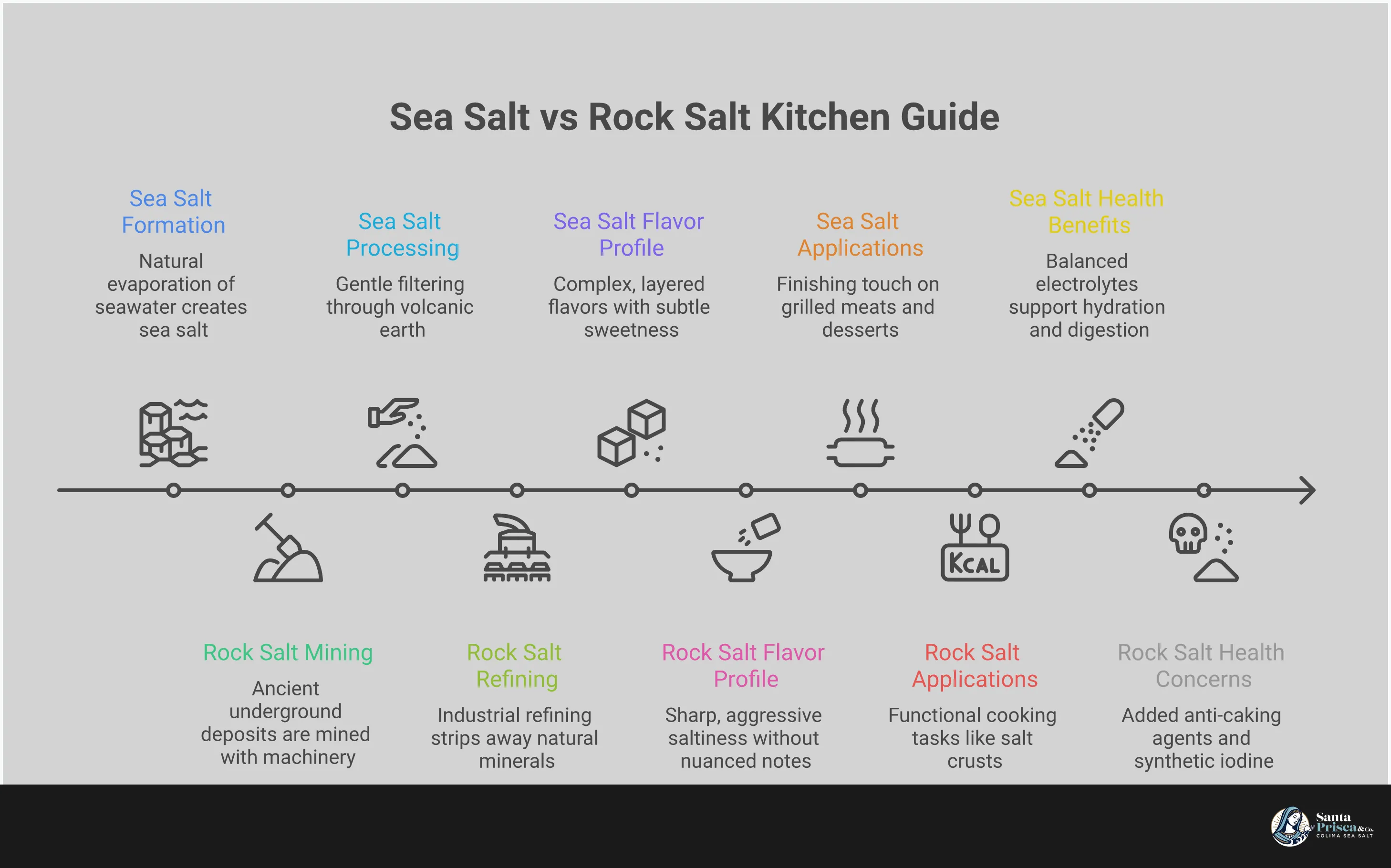
The Complex, Nuanced Taste of Sea Salt
Unrefined sea salt offers a taste that is layered and alive. Because it keeps its full spectrum of trace minerals, it provides a more complex flavor that supports your body’s needs. Think of it as the difference between a single note and a full chord. Our Colima Sea Salt, for example, is naturally filtered through volcanic earth, a process that enriches it with a unique mineral profile. The result is a crisp, clean flavor with a beautiful mineral depth that enhances every dish it touches, from a simple slice of tomato to a perfectly seared steak. It doesn’t just add saltiness; it adds character.
The Sharp, One-Note Flavor of Rock Salt
If sea salt is a symphony of minerals, rock salt is more of a solo instrument. Mined from ancient seabeds and heavily processed, it is stripped of most of its trace minerals, leaving behind almost pure sodium chloride. This gives it a sharp, aggressive saltiness without the subtle nuances found in sea salt. While both are salty, rock salt’s flavor is much more straightforward. Its large, chunky crystals don’t dissolve easily, making them less ideal for finishing a dish. Instead, this intense, direct flavor profile is better suited for processes like brining, pickling, or making ice cream, where a pure saline quality is all that’s required.
A Look at the Nutritional Profile
When we talk about salt, it’s easy to think of it as a single, uniform ingredient. But the journey an individual salt crystal takes from its source to your kitchen has a profound impact on its nutritional makeup. The conversation around salt and wellness often gets oversimplified, focusing only on sodium. To truly understand its role in our bodies, we have to look closer at the source.
Refined table salt is a product of heavy industrial processing. It’s stripped of its companion minerals, often bleached, and treated with anti-caking agents to ensure it flows freely from a shaker. What’s left is almost pure sodium chloride, a one-dimensional ingredient that delivers saltiness but little else.
Unrefined sea salt, on the other hand, tells a much richer story. When seawater evaporates under the sun, it leaves behind not just sodium chloride, but a complex mosaic of minerals and trace elements from the ocean. This natural composition is what gives authentic sea salt its unique character, both in flavor and in how it interacts with our bodies. It’s a whole food, complete with the elements that nature intended.
The Trace Minerals in Natural Sea Salt
Unlike processed table salt, unrefined sea salt retains its full spectrum of trace minerals, offering a more complex flavor and supporting your body’s needs. The balanced minerals in natural sea salt help your body properly use the water you drink and support the digestive processes needed to absorb key nutrients from your meals.
This is something you can taste. The mineral-rich profile of Colima Sea Salt provides a gentle, nuanced flavor rather than a sharp, aggressive saltiness. Each crystal carries hints of its origin, adding a subtle depth that enhances food without overpowering it. It’s a difference that speaks to the wholeness of the ingredient.
What to Know About Iodine and Additives
Many people choose iodized table salt to ensure they get enough of this essential nutrient. What isn't widely known is that rock salt, the source of most table salt, is stripped of its natural minerals (including any iodine) during processing. Iodine is then artificially added back in, along with anti-caking agents and bleaching chemicals.
Sea salt, however, naturally contains a variety of minerals absorbed from the ocean, including iodine, iron, sulfur, and magnesium. By choosing an unrefined sea salt, you are getting these elements as part of a whole package, just as nature created them. This avoids the additives found in processed salt and provides a more natural source for these important nutrients.
Common Myths About Salt and Wellness
It’s important to approach wellness with a sense of balance. While we celebrate the benefits of mineral-rich sea salt, it’s also true that consuming too much sodium from any source can be linked to health issues. Getting enough sodium is essential for fluid balance, hydration, and digestion, but the key is moderation.
The goal isn’t to consume more salt, but to choose a better salt. By replacing refined table salt with a pure, unrefined sea salt, you introduce beneficial trace minerals into your diet while seasoning your food with intention. It’s a simple shift that honors your body and brings a deeper appreciation to the act of cooking.
How to Use Each Salt in Your Kitchen
Understanding the distinct character of each salt allows us to cook with more intention. The salt you choose is more than just a seasoning; it’s a final, thoughtful touch that can define a dish. Knowing when to reach for a delicate, mineral-rich sea salt versus a coarse rock salt is the key to bringing out the best in your ingredients and creating moments of true connection around the table.
Think of your salt selection as a palette. Each type has a unique texture, flavor, and purpose. Using them correctly not only improves your cooking but also deepens your appreciation for the simple, powerful role that salt plays in every meal.
When to Use Sea Salt for Finishing and Flavor
Unrefined sea salt is all about flavor and texture. Its delicate, complex taste comes from a full spectrum of trace minerals, a gift from the sea where it was born. This is the salt you use when you want to add a final flourish to a dish, allowing its character to shine.
Sprinkle a pinch of flaky Colima Sea Salt over a perfectly cooked steak, a ripe avocado, or a dark chocolate dessert. The crisp flake provides a satisfying crunch and a burst of mineral depth that lingers on the tongue. Because its minerals help your body absorb nutrients and hydrate effectively, using a natural sea salt is a simple way to support your digestive wellness while enhancing every bite. It’s best reserved for finishing, where its subtle qualities won’t get lost in the cooking process.
The Specific Roles of Rock Salt in Cooking
Rock salt has a different, more functional role in the kitchen. Because it is mined from large, underground deposits, it’s less expensive and has a harsher, more direct saline flavor. It lacks the nuanced mineral notes of a hand-harvested sea salt, making it less ideal for finishing a dish.
Instead, rock salt is a workhorse for specific culinary tasks. Its large, chunky crystals are perfect for creating a salt crust on meats or fish, which seals in moisture beautifully. It’s also the salt of choice for making homemade ice cream, where it’s used to lower the freezing temperature of the ice surrounding the canister. A guide to different salts can be helpful for understanding these more industrial applications where a delicate flavor is not the primary goal.
Why Purity and Processing Matter
Not all salt is created equal. The journey an ingredient takes from its source to your kitchen table defines its character, its flavor, and its effect on your body. When it comes to salt, the difference between a minimally touched, sun-dried crystal and a heavily processed grain is immense. Think of the way wine connoisseurs speak of terroir, the unique taste imparted by the soil and climate of a specific place. Salt has its own version of this, absorbing the essence of the ocean and earth it comes from. Our salt, for instance, is naturally filtered through volcanic earth, a process that gives it a story and a soul.
This connection to place is often the first thing lost in industrial processing. The goal becomes uniformity, stripping away the very characteristics that make an ingredient special. This isn't just about flavor; it's about choosing to bring foods into our homes that are as close to their natural state as possible. Understanding this distinction allows us to cook with more intention, choosing ingredients that truly nourish us and honor the food we prepare. It’s about appreciating the subtle complexities that nature provides and recognizing what is lost when those complexities are stripped away for the sake of convenience or consistency.
The Benefits of Unrefined Sea Salt
When sea salt is harvested gently and left unrefined, it retains a beautiful integrity. Think of it as a whole food. Our Colima Sea Salt keeps its full spectrum of trace minerals from the sea, which gives it a more complex, almost sweet flavor that enhances food without overpowering it. These naturally occurring minerals do more than just create a nuanced taste; they also support your body's needs for hydration and balance. This is why unrefined salt has a softer, more resonant impact on the palate. It’s a seasoning that works in harmony with your ingredients, adding a burst of mineral depth that processed salts simply cannot replicate.
How Additives Affect Rock Salt's Quality
In contrast, most common table salt begins as rock salt that undergoes intense processing. This refining process strips away the trace minerals, leaving behind almost pure sodium chloride. To prevent clumping, manufacturers often include anti-caking agents. The salt may also be bleached to achieve a uniform white color. Because essential minerals like iodine are removed, it is often added back in synthetically. The result is a salt with a sharp, aggressive flavor that can easily overwhelm a dish. It lacks the gentle complexity of its unrefined counterpart, offering a one-dimensional saltiness instead of a rich, mineral-forward taste that complements and completes a meal.
Choosing a Salt with Intention
The salt you choose is more than just a seasoning. It’s a quiet decision that shapes the entire character of a dish, from its flavor to its nourishing qualities. When we choose with intention, we invite a deeper connection to our food and the earth it comes from. This simple act of mindfulness can transform your cooking, turning a common ingredient into a source of genuine nourishment and pleasure.
Think about the difference in taste. Highly processed salts often have a sharp, one-note flavor. But an unrefined sea salt carries the story of its origin. The unique minerals it gathers from the ocean and earth give it a complex, almost sweet taste that enhances food rather than just making it salty. This is where you find that beautiful, lingering mineral depth that brings a meal to life.
Beyond flavor, this choice touches on wellness. Unlike processed table salt, unrefined sea salt retains its full spectrum of trace minerals, which are essential for our bodies. These natural elements are what our systems recognize and know how to use. Choosing a salt rich in these minerals is a simple way to support your body's needs with every meal. So, the next time you reach for the salt, pause for a moment. Consider its journey, its purity, and what it brings to your table.
Related Articles
- Sea Salt for Cooking: Types, Benefits, and How to Use It Like a Pro
- Buy Natural Sun Dried Sea Salt: A 2026 Guide
- Best Sea Salt for Health | Guide to Healthy Cooking Salt
- Best Sea Salt for Health | Why Colima Stands Out
Frequently Asked Questions
What's the simplest way to remember the difference between sea salt and rock salt? Think of it this way: sea salt is a gift from the living ocean, while rock salt is an artifact from ancient earth. Sea salt is gently harvested by evaporating seawater, a process that preserves its natural trace minerals and complex flavor. Rock salt is mined from underground deposits and then heavily processed, which strips away those minerals and leaves a sharper, more one-dimensional taste.
Is sea salt actually better for you than regular table salt? It’s less about one being "healthier" and more about choosing a whole, unprocessed ingredient. Unrefined sea salt contains a full spectrum of trace minerals that our bodies recognize and use for things like hydration and digestion. Most table salt, which comes from rock salt, is stripped of these companion minerals and then treated with additives. By choosing an unrefined sea salt, you are seasoning your food with a complete, natural mineral source.
Can I just swap sea salt for table salt in my recipes? It’s best not to swap them one-for-one. The size and shape of the salt crystals are very different, which affects how they measure and dissolve. Flaky sea salt is much lighter and less dense than fine-grained table salt, so a teaspoon of each will not provide the same level of saltiness. Sea salt truly shines when used as a finishing touch, where its unique texture and flavor can be fully appreciated.
Why is unrefined sea salt considered a "finishing" salt? A finishing salt is all about that final flourish you add to a dish right before it’s served. The delicate, crisp texture and nuanced mineral flavor of a quality sea salt are best experienced fresh. If you were to cook with it, those beautiful qualities would dissolve and get lost in the dish. Sprinkling it on at the end adds a satisfying crunch and a clean burst of flavor that truly completes the meal.
Does it really matter where my sea salt comes from? Absolutely. Just as the soil and climate give wine its unique character, a salt’s origin shapes its flavor and mineral profile. The body of water, the method of harvesting, and even the earth the water touches all contribute to the final product. A salt that is naturally filtered through volcanic earth, for instance, will have a distinct mineral depth and a cleaner taste than a salt harvested elsewhere. The source tells the story of the salt.