
Which Sea Salt Has the Most Trace Minerals? A Guide
Written By Santa Prisca & Co Staff Last updated on
When we talk about food, we often speak of its origin. We want to know which farm our vegetables came from or which coast our fish was caught on. Salt deserves the same thoughtful consideration. It’s not just a generic white crystal; it’s a mineral fingerprint of a specific place on Earth, shaped by the sun, the water, and the land it touched. This connection to place, or terroir, is what gives a salt its unique flavor and nutritional profile. Understanding this story helps us move beyond simple seasoning and toward intentional nourishment, prompting us to ask the important question: which sea salt has the most trace minerals and carries the purest essence of its home?
Key Takeaways
- Choose salt for its supportive minerals, not just its saltiness: Unrefined sea salt provides essential trace elements like magnesium and potassium that are stripped from processed table salt, helping to support your body’s natural balance and hydration.
- A salt’s story shapes its quality: Its mineral profile is a direct reflection of its origin and harvesting method, so choosing a salt from a pure source that uses traditional, gentle techniques ensures you receive the most nourishment.
- Read the label to understand a salt's journey: Look for terms like "unrefined" and "hand-harvested" to ensure the salt is free from additives and retains its natural minerals, offering a more complex flavor that allows you to season your food with less.
What Are Trace Minerals, and Why Does Your Body Need Them?
When we talk about nutrition, we often focus on the big players: protein, carbs, and fats. But deep within our bodies, a quieter, more subtle orchestra is at play, conducted by tiny elements called trace minerals. These are the essential nutrients our bodies need in small, delicate amounts to perform at their best. Think of them not as the main course, but as the finishing salt that brings the entire dish to life.
These minerals, including zinc, iron, copper, and selenium, are fundamental to our vitality. They work behind the scenes in nearly every process, from hormone production to maintaining a steady heartbeat. While the amounts we need are small, their impact is profound. They are the foundation of our inner ecosystem, ensuring everything runs with a gentle, steady rhythm.
The Unsung Heroes of Your Health
Trace minerals are the quiet, diligent workers that support our most critical functions. They are the unsung heroes of our health, helping to build a resilient immune system and produce the energy we need to move through our day with grace. For example, zinc is a loyal guardian of our immune response, while iron is essential for carrying life-giving oxygen through our blood. When we don’t get enough of these minerals, we might feel it as fatigue or notice we’re more susceptible to feeling unwell. Honoring our bodies with mineral-rich foods is a simple act of gratitude for this intricate inner world.
How They Support Your Well-Being
The support of trace minerals extends to every part of our being. They are crucial for clear nerve signaling, healthy muscle function, and maintaining the delicate fluid balance that keeps us hydrated and energized. Every sip of water, every stretch, and every thought is supported by these micronutrients. They are integral to our metabolic rhythm and even help synthesize our DNA. A diet that includes a spectrum of trace minerals is foundational for cognitive clarity and overall wellness. By intentionally choosing ingredients that contain them, we are making a conscious investment in our long-term health and vitality.
Which Sea Salt Is Richest in Trace Minerals?
Not all salts are born from the same waters. Each carries the story of its origin, a unique mineral fingerprint shaped by its environment. From ancient, sun-drenched flats to pristine mountain deposits, the source of a sea salt deeply influences its flavor, texture, and nutritional profile. Exploring these different salts is like taking a journey around the world, one crystal at a time. Understanding their distinct mineral compositions can help you choose the perfect salt to season your food and nourish your body with intention. Let’s look at some of the most celebrated mineral-rich sea salts from across the globe.
Colima Sea Salt: A Treasure from Mexico's Volcanic Earth
Harvested from the sun-kissed waters off the coast of Mexico, Colima Sea Salt is a true gift from the earth. Its journey begins in a pristine lagoon, where the water is naturally filtered through ancient volcanic soil. This unique process enriches the salt with a wealth of minerals, giving it a complex flavor and a delicate, crunchy texture. The hand-harvesting tradition, passed down through generations, ensures that every crystal retains its natural integrity. This is a salt that doesn’t just season your food; it connects you to a place of incredible natural purity and artisanal heritage, making it a favorite for those who cook with wellness in mind.
Celtic Sea Salt: The Pride of France
From the coastal region of Brittany, France, comes Celtic Sea Salt, known for its distinctive light grey hue and moist texture. This salt is hand-raked from clay-lined salt beds, a traditional method that allows it to retain its natural moisture and a rich array of minerals. It’s particularly noted for its high concentration of magnesium, calcium, and potassium. Because it is completely unrefined, it holds onto its natural mineral composition without any added chemicals. This salt’s briny, complex flavor and unique texture make it a beautiful finishing salt, though some common salt misconceptions often surround its specific health benefits.
Himalayan Pink Salt: Mined from Ancient Seabeds
Himalayan Pink Salt is perhaps one of the most recognizable sea salts, celebrated for its beautiful rosy color. It is sourced not from today’s oceans, but from ancient sea salt deposits deep within the mountains of Pakistan. This salt is said to contain up to 84 different trace minerals, which give it its signature pink hue. These minerals are important for maintaining the body’s electrolyte balance and supporting nutrient absorption. As one of the best sea salts for health, its mild flavor and stunning appearance have made it a staple in kitchens around the world for both cooking and presentation.
Baja Gold Sea Salt: Harvested from the Sea of Cortez
Harvested from the vibrant and biodiverse Sea of Cortez, Baja Gold Sea Salt has earned a reputation for being exceptionally rich in minerals. The unique tidal-and-current action in this region creates a concentrated brine that yields a salt with a remarkable spectrum of trace elements. Proponents of Baja Gold Signature Mineral Sea Salt highlight its role in supporting essential bodily functions, from nerve signaling and muscle movement to maintaining healthy blood pressure. Its potent, full-bodied flavor reflects the richness of the waters from which it came, offering a powerful taste of the sea.
Dead Sea Salt: A Unique Mineral Composition
While most sea salts are celebrated for their culinary uses, Dead Sea Salt is famous for its therapeutic properties. Sourced from the hyper-saline waters of the Dead Sea, it has a mineral composition unlike any other salt on Earth. It is exceptionally high in magnesium, calcium, potassium, and zinc, but its bitter taste makes it unsuitable for cooking. Instead, these minerals are highly beneficial for skin health. Often used in baths and skincare, Dead Sea Salt can help soothe skin conditions like eczema and acne while gently detoxifying the skin, making it a staple for wellness rituals rather than kitchen creations.
A Side-by-Side Look at Sea Salt Minerals
Not all sea salts are born from the same waters or touched by the same hands. The subtle differences in their mineral makeup create a spectrum of flavors, textures, and even wellness benefits. When we look closer, we see that each crystal tells a story of its origin, from the volcanic earth of Colima to the ancient seabeds of the Himalayas. Understanding these nuances helps us choose a salt that truly nourishes our bodies and enriches our cooking.
It’s a beautiful practice to become more intentional with our ingredients, and salt is one of the most fundamental. Let’s explore what sets these precious crystals apart.
Breaking Down the Mineral Content
When you choose an unrefined sea salt, you’re getting more than just sodium chloride. You’re getting a complex blend of trace minerals that the ocean and earth have to offer. Natural sea salt retains elements like magnesium, potassium, and calcium, which are essential for various bodily functions, from muscle movement to nerve health.
Some salts boast a much higher mineral content than common table salt or even other sea salts. This mineral richness isn’t just for show; it contributes to a rounder, more nuanced flavor that enhances food without overwhelming it. It’s the difference between a flat, one-note saltiness and a gentle burst of mineral depth that lingers on the tongue.
Finding the Right Balance: Sodium and Trace Minerals
It’s a common misconception that all salt is the same. While sodium is a key component of every salt, the presence of other minerals creates a more balanced profile. Unrefined salts like our Colima Sea Salt are naturally lower in sodium by volume because of the space these other essential minerals occupy within each crystal.
While the amounts of trace minerals can be subtle, they work in harmony to create a salt that’s both flavorful and supportive of your well-being. This balance is what makes a high-quality sea salt so special. It allows you to use less while enjoying a fuller, more complex flavor, turning a simple seasoning into a mindful act of nourishment.
How Harvesting Methods Impact Minerals
The journey a salt takes from the sea to your kitchen table is a beautiful story, and the way it’s told has everything to do with its final character. Not all salt is gathered equally. The method used to harvest it is perhaps the single most important factor in determining its mineral content, flavor, and texture. A salt’s true potential is either protected by careful hands or stripped away by industrial machinery.
When we choose a salt, we’re choosing a philosophy. Do we want something that has been rushed and refined, or something that has been patiently coaxed from nature, carrying all of its complexity with it? The difference is profound. An industrial salt is a blunt instrument of pure sodium, while an artisan-harvested salt is a delicate symphony of minerals that speaks of its origin. Understanding these harvesting methods helps us appreciate the integrity of what we put into our bodies and bring to our food.
The Artisan's Touch: Hand-Harvested vs. Machine-Processed
Imagine the quiet, rhythmic work of a salt farmer, or salinero, gently skimming delicate crystals from the surface of a sun-drenched salt flat. This is the essence of hand-harvesting. It’s a slow, intentional process that honors the salt’s natural structure. Because it’s so gentle, this method ensures the salt retains more of the natural minerals found in the seawater.
In contrast, machine-processing often involves heavy equipment that scrapes and collects salt with less precision. This aggressive approach can damage the salt’s delicate crystalline structure and introduce impurities. The artisan’s touch preserves the salt’s integrity, resulting in a product that is not only richer in minerals but also offers a more nuanced flavor and a satisfying, crisp texture.
Unrefined vs. Refined: What's Lost in Processing?
The distinction between unrefined and refined salt is where the story of minerals truly unfolds. An unrefined sea salt is simply evaporated seawater, carrying with it a beautiful spectrum of trace minerals from its source. It’s pure, whole, and untouched by chemicals.
Refined salt, like common table salt, undergoes heavy industrial processing. It’s often washed, bleached, and heated to extreme temperatures, which strips away nearly all of its beneficial minerals. What’s left is almost pure sodium chloride. To make matters worse, additives like anti-caking agents are often mixed in. The more a salt is processed, the fewer valuable minerals it has, leaving you with a one-dimensional flavor and none of the wellness benefits.
The Role of Volcanic Earth in Preserving Minerals
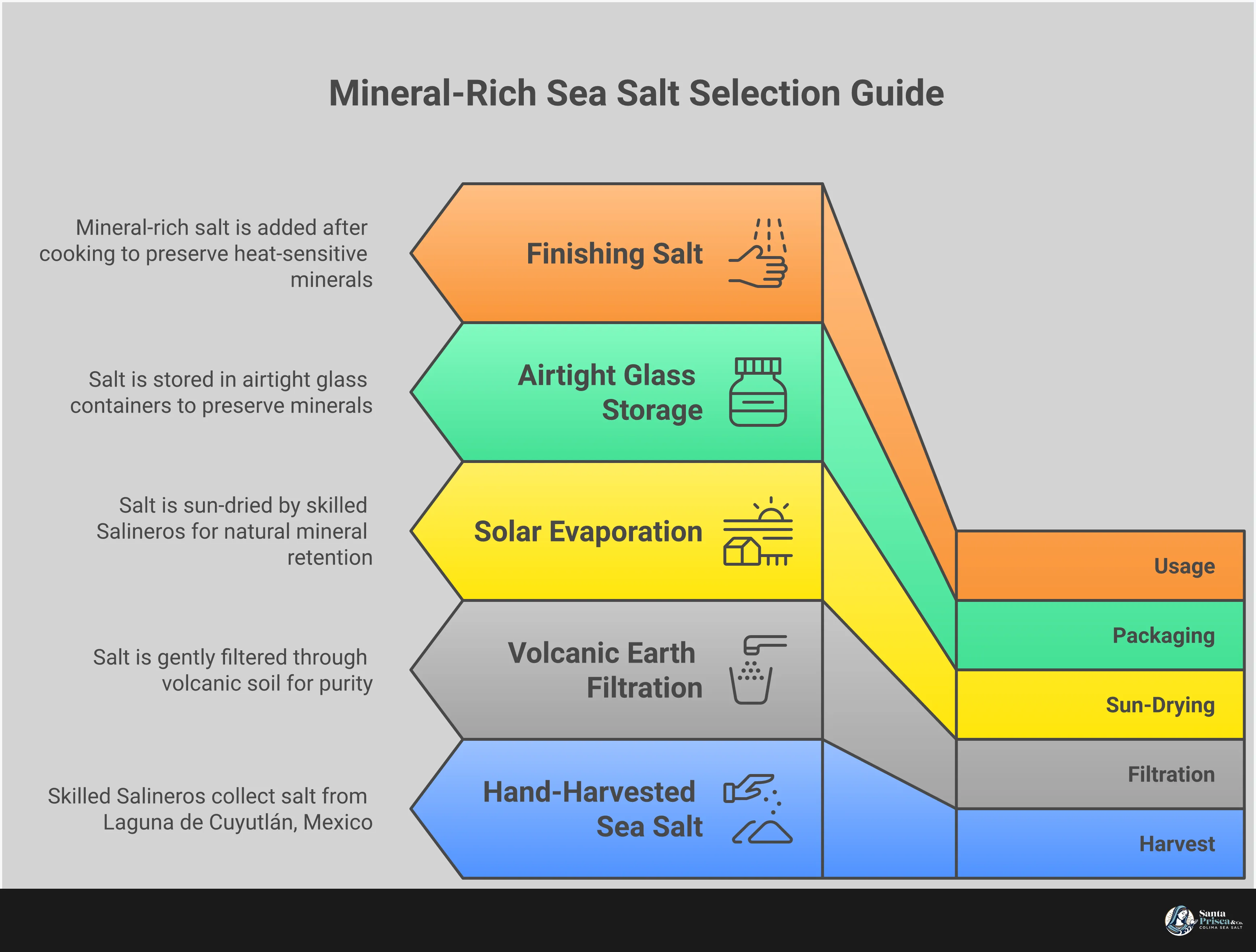
The land itself plays a vital role in a salt’s mineral composition. Our Colima Sea Salt comes from a place of incredible natural power, where saltwater from the Cuyutlán Lagoon is naturally filtered through ancient volcanic earth. This unique environment acts as a pristine, mineral-rich filter, infusing the salt with a remarkable profile that you can’t find anywhere else.
This natural filtration, combined with careful, traditional harvesting methods, is what preserves the salt’s exceptional mineral content. The volcanic soil doesn’t just purify; it enriches. It’s a perfect collaboration between the earth and the sun, resulting in a salt that is a true expression of its unique terroir and a testament to the power of nature.
Key Trace Minerals to Look For in Your Sea Salt
When we talk about salt, it’s easy to think only of sodium. But a truly exceptional sea salt, like our hand-harvested Colima Sea Salt, offers so much more. It carries a whisper of the earth and sea, a complex profile of trace minerals that refined table salt has long since lost. These minerals are the quiet contributors to our well-being, working in harmony to support our bodies. Getting to know them helps us appreciate the story behind each crystal and choose a salt that truly nourishes.
Magnesium: For Calm Muscles and a Healthy Heart
Think of magnesium as the mineral of calm and relaxation. It’s essential for helping our muscles release tension, supporting steady nerve function, and maintaining a healthy heart rhythm. When our bodies have enough magnesium, we feel more grounded and at ease. This powerful mineral also plays a role in regulating blood sugar and blood pressure. Choosing a mineral-rich sea salt is a simple, beautiful way to add a touch more of this vital element to your daily meals and support your body's natural harmony.
Potassium: A Key to Balanced Blood Pressure
Potassium is the beautiful counterpart to sodium, working together to maintain the delicate fluid balance in our bodies. This partnership is crucial for healthy hydration, proper muscle contractions, and clear communication between our nerves. By helping to counterbalance sodium, potassium can also play a supportive role in maintaining healthy blood pressure. When you season your food with an unrefined sea salt, you’re not just adding flavor; you’re inviting this essential mineral to the table to help your body find its equilibrium.
Iron, Zinc, and Copper: Your Immune System's Allies
While needed in smaller amounts, minerals like iron, zinc, and copper are mighty allies for our health. They are fundamental to a strong immune system, helping our bodies defend and repair themselves. These minerals also contribute to steady energy production, keeping us feeling vibrant throughout the day. It’s a gentle reminder that even the smallest components can have a profound impact. Choosing a salt that retains these trace elements is an act of intention, a way of honoring the nutritional gifts the earth provides.
Calcium and Selenium: Essential for Overall Well-Being
We often associate calcium with strong bones and teeth, and for good reason. But its role extends far beyond our skeletal structure; it’s also vital for muscle movement and nerve signaling. Some unrefined sea salts have a surprising calcium content, adding another layer of nourishment to your cooking. Alongside calcium, you’ll often find selenium, an antioxidant that helps protect our cells. Together, these minerals contribute to the intricate web of functions that keep our bodies running smoothly. Each pinch of mineral-dense salt is a small offering of support for your overall vitality.
How Mineral-Rich Sea Salt Can Support Your Health
When we choose ingredients with intention, we invite more than just flavor into our kitchens. We invite nourishment. Unrefined sea salt, with its complex mineral profile, is a beautiful example of this. Unlike processed table salt, which is stripped of its natural elements, a truly pure sea salt offers a spectrum of trace minerals that our bodies recognize and use. Sprinkling these crystals into a meal becomes a small, mindful act of care, a way to connect with the earth and support your body’s innate wisdom.
This isn’t about a quick fix, but about the gentle, cumulative effect of making conscious choices. By simply seasoning your food, you can introduce essential minerals that contribute to your overall sense of well-being, turning an everyday gesture into a ritual of health.
Supporting Hydration and Electrolyte Balance
True hydration goes beyond the water you drink. It’s about achieving a healthy electrolyte balance that allows your cells to function properly. Unrefined sea salts contain minerals like potassium, magnesium, and calcium, which are essential electrolytes. These elements help your body absorb and use water more effectively, keeping you feeling energized and clear-headed.
Because these salts offer such a rich, full flavor, you may find you need less to feel satisfied. A delicate pinch can provide a burst of mineral depth, allowing you to season your food beautifully while being mindful of your sodium intake.
Aiding Muscle Function and Nerve Health
Think of the constant communication happening within your body, from the steady beat of your heart to the contraction of your muscles. Minerals are the messengers that make it all possible. Magnesium, in particular, is a key player in this intricate network. It helps calm both muscles and nerves, supports stable blood sugar, and contributes to building strong bones.
When your body has the minerals it needs, everything just works a little more smoothly. Incorporating a mineral-rich salt is a simple way to nourish this internal system, supporting everything from a restful night’s sleep to your daily movements.
Contributing to Bone Health and Immunity
A resilient body is built on a strong foundation. Unrefined sea salt contains trace minerals that contribute to two of the most important systems for your long-term health: your bones and your immune system. Calcium is well-known for its role in bone density, but other minerals found in sea salt play a vital part, too.
Elements like zinc, iron, and copper are needed in small amounts to keep your immune system responsive and strong. These minerals work together to support your body’s natural defenses, helping you feel your best from the inside out.
Why a Salt's Origin Story Matters
Have you ever thought about where your salt comes from? Not just the store, but its true home. Like wine or coffee, sea salt has a terroir, a sense of place that defines its flavor, texture, and mineral composition. It carries the story of the water, the sun, and the earth it came from. When we understand a salt’s origin, we connect more deeply with our food and the natural world that nourishes us.
This story isn’t just romantic, it’s practical. The environment where salt is harvested directly shapes its quality. A salt’s journey from a pristine ocean to your kitchen table is what determines whether it’s a flat, one-note seasoning or a complex, mineral-rich ingredient that brings your food to life. Choosing a salt with a transparent origin is an act of intention, a way to ensure you’re seasoning your meals with the purest elements of nature.
The Purity of the Water Source
It all begins with the water. The cleanest, most vibrant sea salts come from water sources that are far from industrial runoff and surface pollutants. Some of the world's most prized salts are harvested from deep ocean waters, which have remained untouched by modern contamination. This initial purity is essential because whatever is in the water will ultimately end up in the salt crystals.
When the source is pristine, the resulting salt is clean and free from the heavy metals or microplastics that can be found in polluted marine environments. This purity allows the salt’s natural mineral character to shine through without any unwanted additions, giving you a clean taste and peace of mind.
The Influence of Sun and Climate
Once the saltwater is collected in shallow pools, nature’s gentlest forces take over. The sun and wind work in harmony, slowly coaxing the water to evaporate and leave behind delicate salt crystals. This unhurried, natural process is crucial for preserving the salt’s complex mineral structure. It’s a patient art, one that allows trace elements to remain integrated within each crystal.
This traditional method stands in stark contrast to industrial salt production, which often uses intense heat to speed up evaporation, a process that can strip away valuable minerals. The slow kiss of the sun ensures the salt retains its full spectrum of minerals, creating a more balanced and flavorful final product.
The Unique Makeup of the Salt Flats
The ground beneath the salt pools plays a vital role in the final chapter of the salt’s story. As the saltwater rests, it interacts with the earth, absorbing unique characteristics from the soil and clay. In the case of Colima Sea Salt, the water is naturally filtered through ancient volcanic earth. This interaction infuses the salt with a remarkable mineral profile that you won’t find anywhere else.
This volcanic foundation acts as a natural filter and a source of enrichment, contributing to a higher mineral content. The result is a salt with a distinct, savory depth and a crisp flake that speaks directly of its volcanic cradle. This is what makes an unrefined, hand-harvested salt so special: it’s a genuine taste of a unique place on Earth.
Common Myths About Sea Salt and Minerals
In the world of wellness, sea salt is often seen as a simple, wholesome ingredient. But as its popularity has grown, so have the stories and claims surrounding it. It can be hard to separate fact from fiction. Let's clear the air and look at some of the most common myths about sea salt, so you can feel confident in the choices you make for your kitchen and your well-being.
Myth: All Sea Salts Are a Major Source of Minerals
While it’s true that unrefined sea salt contains trace minerals that are stripped from table salt, not all sea salts are mineral powerhouses. The truth is, the mineral content can vary significantly depending on the water source, the local geology, and the harvesting method. A salt’s journey from the sea to your table determines what nutrients remain. A truly mineral-rich salt, like our Colima Sea Salt, gets its unique profile from its environment, absorbing elements from the volcanic earth it’s filtered through.
Myth: Every Sea Salt Is Created Equal
Walking down the grocery aisle, you might see dozens of salts labeled "sea salt." It’s easy to assume they’re all the same, but that couldn’t be further from the truth. Everything from the region of origin to the way the salt is processed can impact flavor, texture, and mineral composition. A damp, grey salt from the French coast will taste and feel completely different from a dry, sun-kissed crystal from the lagoons of Mexico. Each has its own story and its own best use in the kitchen.
Myth: You Don't Need to Watch Your Sodium with Sea Salt
This is a crucial point for mindful eating. While unrefined sea salt offers a beautiful array of trace minerals, it is still primarily sodium chloride. The amounts of these minerals are typically very small, so sea salt shouldn’t be seen as a free pass to ignore your sodium intake. Instead, the invitation is to choose quality over quantity. A pinch of a complex, flavorful salt can satisfy your palate more deeply, allowing you to use less while still bringing your food to life. It’s about savoring the flavor and appreciating the balance.
How to Choose a Truly Mineral-Rich Sea Salt
Stepping into the world of artisanal salt can feel like learning a new language. With so many options, how do you find one that truly nourishes your body and delights your palate? The secret lies in looking beyond the price tag and connecting with the story of the salt. Choosing a salt becomes an act of intention when you know what to look for, from the information on the label to the texture between your fingertips. It’s about finding a salt that resonates with your values and brings a deeper sense of wellness to your kitchen.
What to Look for on the Label
The label is your first window into a salt’s journey. Look for keywords like “unrefined” and “hand-harvested,” which signal that the salt has been gently gathered and left in its natural state, complete with its precious minerals. An additive-free promise is another important marker, ensuring you’re getting pure salt without any anti-caking agents.
Remember, not all sea salts are created equal, and the mineral content can vary greatly. A truly exceptional salt, like our Colima Sea Salt, will often share its origin story, telling you where and how it was harvested. This transparency is a beautiful sign of quality and care, connecting you directly to the source.
Considering Flavor, Texture, and Use in the Kitchen
A salt’s mineral content directly influences its flavor and texture. A mineral-rich salt offers a complex, nuanced taste that is far from the one-note sharpness of processed table salt. It brings a gentle burst of mineral depth that enhances food without overpowering it.
Think about how you’ll use the salt. Do you want a delicate, flaky finishing salt to sprinkle over a salad, or a coarser grain that can stand up to cooking? Exploring different salts allows you to find the perfect match for every dish. Let your senses guide you; the right salt will feel as good as it tastes, adding a satisfying crunch and a beautiful visual touch to your meals.
Prioritizing Sustainable and Ethical Sourcing
The story of your salt matters. When you choose a salt that is harvested using traditional, sustainable methods, you are supporting the preservation of ancient practices and the well-being of the local communities who are stewards of the land. Hand-harvesting is a gentle art that honors the natural cycles of the sun, wind, and water, ensuring the salt flats remain pristine for generations to come.
This mindful approach not only protects the environment but also yields a purer, more vibrant salt. By supporting brands committed to ethical sourcing, you become part of a chain of gratitude that extends from your kitchen back to the hands that gathered it. If you’re a chef or retailer, making wholesale inquiries with producers who share these values is a powerful choice.
Where to Find High-Quality, Mineral-Dense Sea Salt
Navigating the world of sea salt can feel overwhelming, with so many options lining the shelves. But once you know what to look for, choosing a salt that truly nourishes your body and enlivens your cooking becomes a simple, intentional act. It’s about looking beyond the label and connecting with the source.
Finding Authentic Salt from Trusted Sources
The truth is, not all sea salts are created equal. The place it comes from, the way it’s gathered, and how it’s processed all play a huge role in its final mineral content and flavor. An authentic, unrefined sea salt often has a slightly damp feel and a beautiful, imperfect crystal structure, signaling that its natural trace minerals are intact. Look for brands that are transparent about their origins and methods. For example, our Colima Sea Salt is hand-harvested from ancient salt flats, a tradition that honors the salt's inherent purity and mineral richness. When you choose a salt from a trusted source, you’re not just buying an ingredient; you’re inviting a story into your kitchen.
A Simple Checklist for Your Next Purchase
Keep these simple points in mind the next time you shop for salt. First, read the ingredient list. It should just say "sea salt," with no anti-caking agents or additives. Look for the word "unrefined" on the packaging, which means the salt hasn't been stripped of its valuable minerals. Consider the source and seek out salts that offer a full spectrum of trace minerals, not just sodium chloride. Finally, choose a salt that resonates with you, whether for its unique texture, its subtle flavor, or the story behind it. Making an informed choice allows you to season your meals with intention and care.
Related Articles
- What's the Difference Between Sea Salt & Rock Salt?
- How to Buy Mineral-Rich Sea Salt the Right Way
- Best Sea Salt for Health | Guide to Healthy Cooking Salt
- Best Sea Salt for Health – Benefits & Buying Tips
- Best Sea Salt for Health: A Complete Buyer's Guide
Frequently Asked Questions
What's the real difference between unrefined sea salt and the white table salt I grew up with? The biggest difference comes down to what’s taken away and what’s left behind. Refined table salt is heavily processed to be almost pure sodium chloride, which strips it of its natural trace minerals. Unrefined sea salt, on the other hand, is simply evaporated seawater, so it retains that beautiful, complex spectrum of minerals from its source. This is why it has a more nuanced flavor and a texture that feels more connected to nature.
If sea salt has beneficial minerals, does that mean I can use more of it? While unrefined sea salt does offer trace minerals, it's still salt and should be enjoyed mindfully. The wonderful thing about a high-quality, mineral-rich salt is that its flavor is so full and complex that you often need less to make your food sing. Think of it as an invitation to choose quality over quantity, savoring each pinch and appreciating the depth it brings to a dish.
With so many sea salts available, what makes Colima Sea Salt different from others like Himalayan or Celtic salt? Each salt tells the story of its home, and Colima Sea Salt has a truly unique origin. It comes from a pristine lagoon where the water is naturally filtered through ancient volcanic earth. This process enriches the salt with a distinct mineral profile you won’t find anywhere else. While other salts have their own beautiful qualities, the volcanic filtration gives our salt its signature savory depth and crisp, delicate texture.
Why is "hand-harvested" so important? Does it really change the salt? It absolutely does. Hand-harvesting is a gentle, intentional practice that honors the salt's natural form. It allows the delicate crystals to be gathered without being crushed or altered, which helps preserve their mineral content and unique texture. Industrial, machine-based methods are often harsh and can strip away the very minerals that make sea salt so special. The artisan's touch ensures the salt arrives in your kitchen as whole and pure as nature intended.
Besides the label, how can I tell if a sea salt is high-quality and rich in minerals? You can often tell by using your senses. A truly unrefined, mineral-dense salt usually won't be a uniform, bright white color; it might have a subtle off-white or greyish hue. It may also feel slightly moist to the touch, which is a sign that it hasn't been kiln-dried and stripped of its elements. Finally, the taste will be complex and mild, not just sharp and aggressively salty.