
How Long Does Sea Salt Last? The Surprising Truth
Written By Santa Prisca & Co Staff Last updated on
We often think of salt as just another seasoning, but at its heart, it’s a pure, timeless mineral. The salt crystals you hold in your hand have existed for millions of years in some form, which is why salt has been a trusted natural preservative for centuries. This enduring quality means it doesn’t spoil or decompose. But that raises the question: how long does sea salt last in your kitchen? While pure, unrefined salt has an indefinite shelf life, its delicate texture and flavor can be affected by its environment. We’ll explore how to honor your salt and keep it at its peak quality for years to come.
Key Takeaways
- Your pure sea salt is timeless: Because it's a natural mineral without additives, pure sea salt doesn't spoil or expire. Any 'best by' date is simply a guideline for optimal texture, not a sign that the salt is no longer good to use.
- Protect its texture with proper storage: Moisture is the only thing that can alter your sea salt's beautiful texture. Keep it in an airtight container in a cool, dry part of your kitchen to prevent clumping and ensure it's always ready for you.
- Clumping is a natural sign of purity: When unrefined sea salt clumps, it's simply reacting to humidity and shows it's free from anti-caking agents. The flavor and quality are completely unaffected, so just break the crystals apart and enjoy.
Does Sea Salt Go Bad?
Have you ever found a container of sea salt tucked away in the back of your pantry and wondered if it’s still good? It’s a common question, but the answer is beautifully simple and rooted in the very nature of salt itself. Unlike most ingredients in our kitchens, pure sea salt doesn’t really have a ticking clock. It’s an ancient mineral with a remarkable ability to stand the test of time.
The Timeless Nature of a Pure Mineral
At its heart, salt is a mineral, sodium chloride, harvested from the earth or sea. Pure minerals don't spoil or decompose. Think of it this way: the salt crystals you hold in your hand have existed for millions of years in some form. They are a timeless piece of the earth. As chemists explain, pure salt is incredibly stable. It doesn't support microbial growth, which is why it has been used as a natural preservative for centuries. This enduring quality is what makes it such a foundational element in our kitchens and in history.
Why Unrefined Sea Salt Lasts a Lifetime
This incredible longevity is especially true for unrefined sea salt. When salt is kept in its pure, natural state, free from anti-caking agents or added iodine, it maintains its integrity indefinitely. Our Colima Sea Salt is a perfect example—hand-harvested and completely pure, it’s a pantry staple that truly lasts a lifetime. Because it’s simply pure salt, it has what experts call an indefinite shelf life. Its quality isn't tied to a date, but to how it’s cared for. This is the beauty of working with ingredients that are exactly as nature intended.
What Do "Best By" Dates on Salt Actually Mean?
So why do some salt packages have a 'best by' date? This date is almost always about quality, not safety. For highly processed table salts, it might indicate the point where added ingredients, like iodine, begin to lose their potency. It can also be a manufacturer's suggestion for when the salt’s texture might change, perhaps becoming clumpy due to moisture exposure. The date is a guideline for peak freshness, not a warning that the salt will expire. For pure, unrefined sea salt without additives, this date is even less of a concern. It’s simply a formality, not a reflection of the salt’s enduring nature.
How Long Does Sea Salt Stay at Its Best?
While pure sea salt is a timeless mineral that doesn’t truly expire, its character can shift over time. Think of it less like spoilage and more like the subtle evolution of a beautiful, natural ingredient. The goal isn’t just to use your salt, but to experience it at its most expressive, with its full mineral complexity and delicate texture intact. Preserving that peak quality is a simple act of care that honors the salt’s journey from the earth to your kitchen. With just a little attention, you can ensure every pinch delivers the vibrant, clean flavor you love.
Preserving Its Perfect Flavor and Texture
Pure, unrefined sea salt is a mineral with an almost eternal lifespan. While it won’t spoil like other foods in your pantry, its delicate qualities can soften over time. To truly honor the journey of our Colima Sea Salt, from the sun-drenched flats to your kitchen, you’ll want to experience its peak expression. Most sources agree that for the most vibrant flavor and perfect crystalline texture, it’s best to enjoy your sea salt within three to five years. This isn't a strict rule, but a gentle guideline for savoring that burst of mineral depth and the crisp flake that makes each meal special.
The First Signs of Change in Your Salt
The first whisper that your sea salt might need attention is a change in its texture. Have you noticed your once-loose, flowing crystals beginning to stick together? This is the most common sign of change, and it’s almost always caused by one simple thing: moisture. When humidity finds its way into your salt container, the crystals can begin to clump, feeling dense and heavy rather than light and airy. This doesn't mean the salt has lost its purity or flavor, but it is a signal that its storage environment might need a little adjustment to keep it perfectly dry and ready for your table.
How to Know When Your Salt Needs a Little Care
If you find your beautiful sea salt has hardened into a solid block, don’t worry. This is simply a sign of moisture, and the salt itself is still perfectly good to use. You can easily break it apart with a fork or the back of a spoon. For a finer texture, a quick pulse in a spice grinder or a gentle turn in a mortar and pestle will restore its flow. The "best by" date you might see on salt packaging is more about maintaining its texture than safety. For an unrefined salt without additives, this date is less a deadline and more a suggestion for enjoying its optimal quality.
What Affects Your Sea Salt's Quality Over Time?
Pure, unrefined sea salt is one of the most stable minerals on earth. It has existed for millions of years and will easily outlast everything else in your pantry. Because it’s a natural preservative, it doesn’t spoil or expire in the way other foods do. When you hold a crystal of Colima Sea Salt, you’re holding something truly timeless.
However, while the salt itself remains pure, its texture and form can be influenced by its environment. Think of it less like spoilage and more like a natural response to its surroundings. The primary factors that can alter your salt’s beautiful, crystalline state are moisture and, in the case of processed salts, the additives mixed in with the sodium chloride. Understanding these simple elements is the key to preserving the unique character of your hand-harvested sea salt for years to come. It’s a small act of care for an ingredient that brings so much life to our food.
Why Moisture Is Salt's Only Real Enemy
If sea salt has one vulnerability, it’s moisture. Salt is hygroscopic, which means it naturally attracts and holds water molecules from the surrounding air. You’ve likely seen this happen in a salt shaker on a humid day. The salt begins to stick together, losing its delicate, free-flowing texture.
Salt can absorb moisture from the air, which is what causes it to clump. This is especially true for unrefined sea salts that are free from anti-caking agents. While this clumping doesn’t mean the salt has gone bad, it can make it a little harder to pinch or sprinkle. It’s simply the mineral returning to a more solid state, a gentle reminder of its connection to the sea.
How Additives Impact Purity and Longevity
This is where the distinction between pure sea salt and common table salt becomes clear. Many commercial salts contain more than just sodium chloride. They often include iodine, anti-caking agents like sodium aluminosilicate, or even dextrose (a form of sugar) to stabilize the iodine.
These added ingredients are not as stable as the salt itself. As Morton Salt explains, these additives can change over time, potentially losing their potency or altering the salt's flavor and color. Because our Colima Sea Salt is completely unrefined and free of additives, you never have to worry about this. Its purity is its strength, ensuring the flavor you experience today is the same one you’ll enjoy years from now.
The Importance of a Stable, Dry Environment
Caring for your sea salt comes down to one simple principle: keeping it dry. A stable environment, away from humidity and temperature swings, is all it needs to maintain its perfect texture and mineral depth. When stored correctly, pure salt has a virtually indefinite shelf life.
Think of your kitchen. The air above a boiling pot of pasta, the steam from a dishwasher, or the humidity near a sink can all introduce moisture. Storing your salt away from these areas helps protect its delicate structure. By providing a dry, dark home for your salt, you honor the journey it took from the pristine salt flats of Colima to your table, ensuring every crystal remains as perfect as the day it was harvested.
How to Keep Your Sea Salt Perfectly Fresh
Caring for your sea salt is a simple, grounding ritual. Just as our artisans in Colima carefully harvest each crystal, a little intention in your own kitchen will preserve its pure flavor and delicate texture. These small acts of care ensure every pinch delivers the full, mineral-rich taste of its origin.
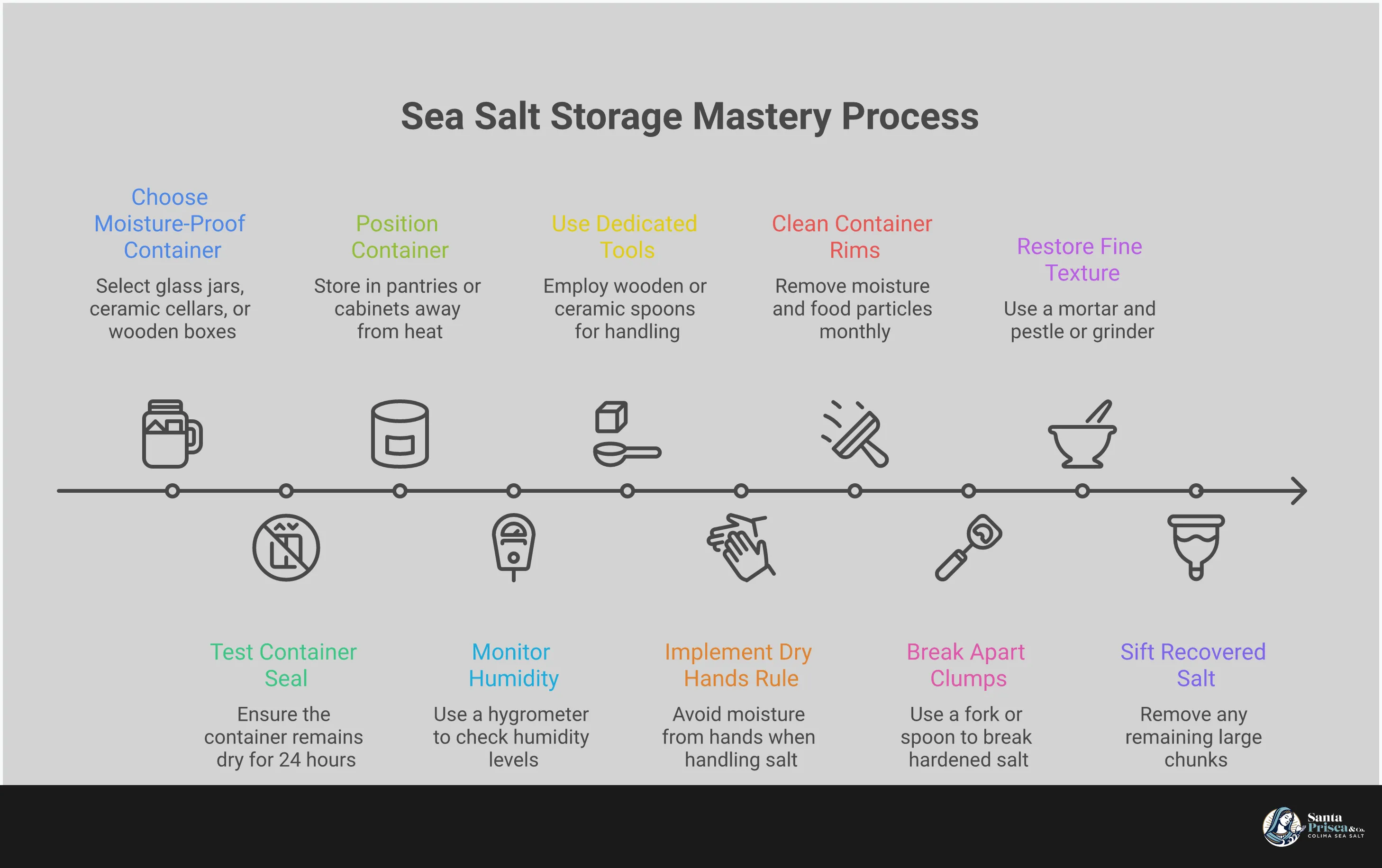
Choose the Right Container
Think of your salt's container as its home. A beautiful, airtight vessel made of glass, ceramic, or wood not only looks lovely on your counter but also protects the salt from moisture. A well-sealed lid is key, as it creates a barrier against humidity and prevents the salt from absorbing other aromas from your kitchen. This simple step keeps each crystal pure, dry, and ready to release its bright, clean flavor. Choosing the right storage container is the first step in honoring this beautiful ingredient.
Find the Best Spot in Your Kitchen
Your sea salt appreciates a calm, quiet environment. The ideal spot is a cool, dry place away from your kitchen’s heat sources, like a pantry or a cabinet. Try to avoid storing it right next to the stove, oven, or dishwasher, as the fluctuating heat and steam can introduce unwanted moisture. Keeping it out of direct sunlight also helps maintain its integrity. Giving your salt a stable home ensures that its delicate crystalline structure remains perfectly intact, preserving that satisfying crunch and the clean, bright flavor that brings your food to life.
Protect It from Humidity and Contaminants
Moisture is the one thing that can truly alter your sea salt. When humidity seeps in, the salt can begin to clump, losing that lovely, free-flowing texture we adore. To protect it, always make sure your hands or spoons are completely dry before dipping into your salt cellar. A small, dedicated spoon is a wonderful tool for this. This mindful practice prevents contamination from water or oils, which can affect the salt's purity. It’s a small gesture of respect for an ingredient that has traveled so far to grace your table.
A Special Note for Storing Unrefined Sea Salt
Our Colima Sea Salt is beautifully unrefined, meaning it’s free from the anti-caking agents found in common table salt. This purity is what gives it such a rich mineral profile and complex flavor. It also means the salt is more likely to absorb moisture from the air. While it will never truly spoil, we find its texture and vibrant taste are at their absolute peak within a few years of harvesting. Storing it carefully ensures you experience every nuance, from its sun-dried crispness to its subtle mineral depth, just as nature intended.
What to Do If Your Sea Salt Clumps?
Have you ever reached for your beautiful sea salt, only to find it has formed into a solid crystal? Don’t worry. This is actually a good sign. Pure, unrefined sea salt, like our Colima Sea Salt, is free from the anti-caking agents found in common table salt. Clumping is simply a natural reaction to a bit of moisture in the air, a testament to its purity. Your salt is still perfect, and bringing it back to its beautiful, crystalline state is simple.
Simple Ways to Bring It Back to Life
When your sea salt hardens, it just needs a little gentle encouragement to return to its original texture. The flavor and rich mineral content remain completely unchanged. You can easily break it up with a spoon or fork, tapping gently until the crystals separate. For a larger, more stubborn clump, you can place it in a bag and carefully tap it on a countertop. If you prefer a finer grain for a specific dish, a few quick pulses in a clean spice grinder or a mortar and pestle will restore its delicate, powdery form, ready to dissolve perfectly into your cooking.
How to Prevent Clumping in the First Place
The best way to care for your sea salt is to protect it from its one true enemy: humidity. Creating the right home for your salt is a simple ritual that preserves its texture. Store it in a cool, dry place, like a pantry or cupboard, away from the steam of a boiling pot or a running dishwasher. The ideal container is one that seals tightly, like a glass jar with a clamp lid or a ceramic salt cellar. This simple step keeps moisture out and ensures your salt is always ready to sprinkle, pinch, or measure with ease.
Is Clumped Salt Still Good to Use?
Absolutely. Clumped sea salt is perfectly safe and delicious to use. Because salt is a stable mineral, it doesn't spoil or expire. The clumping is just a physical change caused by moisture absorption, not a sign of degradation. The salt’s complex flavor profile and mineral depth are completely intact. In fact, seeing your unrefined salt clump is a reminder that it’s pure and natural, without any unnecessary additives. Simply break it apart and continue to enjoy the burst of clean, crisp flavor it brings to every meal.
Related Articles
- How to Store Sea Salt and Keep It Fresh (No Clumps, No Waste)
- Find the Perfect Container for Salt: Our Top Picks
- A Chef's Guide to the Highest Quality Sea Salt
- Choosing Coarse Salt for Pretzels and Finishing
- 8 Types of Gourmet Salt to Elevate Your Cooking
Frequently Asked Questions
My salt has a "best by" date. Does that mean I have to throw it out after that date? Not at all. That date is simply a manufacturer's suggestion for peak quality, not a safety deadline. For a pure, unrefined sea salt, it's mostly a formality. The salt itself is a timeless mineral that won't spoil. The date might just indicate when the texture could begin to change if it's exposed to humidity, but the salt remains perfectly good to use.
Why does your Colima Sea Salt clump when my regular table salt doesn't? That clumping is actually a beautiful sign of purity. Our salt is completely unrefined and doesn't contain any anti-caking agents, which are chemicals added to most table salts to prevent them from sticking together. When our salt clumps, it's just naturally reacting to moisture in the air, proving it's as pure as nature intended.
Will my sea salt lose its flavor if I keep it for a long time? The inherent flavor of the salt, which comes from its rich mineral profile, won't disappear. However, to experience its most vibrant and complex taste, along with its perfect crisp texture, we suggest enjoying it within a few years of harvesting. Think of it like savoring any high-quality ingredient at its absolute peak expression.
My salt has turned into one solid block. Is it ruined? It's definitely not ruined; it just absorbed a bit too much moisture from the air. You can easily bring it back to life. Place the block in a bag and gently tap it on the counter to break it apart. For a finer texture, a quick turn in a mortar and pestle or a clean spice grinder will restore its beautiful, flowing form.
What is the absolute best kind of container for storing sea salt? The best home for your salt is any container with a tight-fitting lid that keeps out humidity. A glass jar with a clamp lid, a wooden salt box, or a ceramic salt cellar are all wonderful choices. The material is less important than the seal, which protects the salt's delicate texture and keeps it pure and ready for your kitchen.