
Fine Grain Sea Salt vs Kosher Salt: The Key Differences
Written By Santa Prisca & Co Staff Last updated on
One salt is mined from ancient seabeds, remnants of oceans that disappeared millions of years ago. The other is a gift from the living sea, born from sun-warmed water and harvested by hand. This fundamental difference in origin is what truly defines the comparison of fine grain sea salt vs kosher salt. One is a refined, purified tool designed for consistency. The other is a whole, natural ingredient that carries the mineral-rich story of its home. Choosing between them isn’t just about taste; it’s about deciding what kind of story you want to tell with your food.
Key Takeaways
- Flavor Follows the Source: Understand that kosher salt is mined for a clean, consistent taste, while unrefined sea salt is born from the ocean, carrying subtle trace minerals that create a more complex, nuanced flavor.
- Season with Intention: Reach for coarse kosher salt as a foundational seasoning during the cooking process, and use a delicate, hand-harvested sea salt as a finishing touch to add a final layer of texture and mineral-rich flavor.
- Measure with Awareness: Remember that a teaspoon of fine sea salt is saltier than a teaspoon of coarse kosher salt due to its smaller, denser crystals. When substituting, start with less fine sea salt and adjust to taste to ensure perfectly seasoned results.
Fine Grain Sea Salt vs. Kosher Salt: What's the Real Difference?
In most kitchens, you’ll find at least two kinds of salt: kosher and sea salt. They look and feel different, but what truly sets them apart? It’s more than just the shape of the crystal; it’s a story of origin, texture, and the subtle minerals that give each salt its unique voice. Understanding these differences is the first step to seasoning with intention and bringing out the very best in your ingredients.
How Are They Made?
The story of a salt begins with its source. Kosher salt is typically mined from underground salt deposits—ancient seabeds left behind millions of years ago. Sea salt, on the other hand, is a gift from the ocean, born from evaporating saltwater. Imagine shallow pools warmed by the sun, slowly transforming into delicate crystals. This natural method of making sea salt is a patient one, guided by sun and wind, allowing the salt to retain its connection to the sea.
From Flakes to Crystals: A Look at Texture
Texture is where you can truly feel the difference. Kosher salt is known for its large, coarse, flaky grains. These irregular shapes are easy to pinch and sprinkle, which is why many chefs love them. Fine grain sea salt offers a different experience. Its crystals are smaller and more uniform, dissolving quickly and evenly. This makes it incredibly versatile for everything from cooking to finishing. Our own Colima Sea Salt has a crisp, delicate flake that melts on the tongue, a testament to the gentle harvesting that preserves its natural structure.
What's Inside? Minerals and Purity
Beyond texture, the composition of these salts tells another part of the story. Kosher salt is almost entirely pure sodium chloride, celebrated for its clean taste and lack of additives. Sea salt shares this purity but carries with it a whisper of its ocean home. As the water evaporates, it leaves behind trace minerals like magnesium and potassium. While the nutritional impact is subtle, these minerals contribute to a more complex, nuanced flavor. This is what gives unrefined sea salt its unique character, connecting your palate directly to its source.
A Tale of Two Flavors: How Do They Compare?
At first glance, salt is just salt. But place a crystal of kosher salt and a grain of sea salt on your tongue, and you’ll discover two entirely different stories. One speaks of industrial precision, while the other whispers of its journey from the sea. Kosher salt is refined to be a pure, consistent culinary tool. Sea salt, on the other hand, carries the essence of its origin—the sun, the wind, and the water it came from. This fundamental difference in their creation is what shapes their character and determines how they express themselves in your cooking. While both bring salinity, they arrive at it from completely different paths, offering unique experiences for the palate. Understanding this distinction is the first step to cooking with more intention and bringing a deeper sense of place to your food.
Unpacking Their Unique Tastes
When you taste kosher salt, you get a clean, direct saltiness. Its flavor is straightforward because it’s almost entirely pure sodium chloride, stripped of other minerals. Many chefs appreciate this consistency; it delivers a predictable salty punch without any other interfering notes. Its large, flaky texture also dissolves slowly, making it ideal for seasoning by hand.
Fine grain sea salt offers a gentler, more nuanced experience. The flavor is still salty, of course, but it’s softer and more complex. It feels less like a sharp note and more like a full chord. This is because it retains the trace minerals from the ocean water it was born from, each one adding a subtle layer to its taste profile.
Why Minerals Matter for Flavor
So, where does that subtle complexity in sea salt come from? The answer lies in the trace minerals left behind during the natural evaporation process—elements like magnesium, calcium, and potassium. While their nutritional contribution is small, their impact on flavor is profound. They don't make the salt less salty, but they do round out the flavor, adding a whisper of the ocean and a gentle, lingering finish that pure sodium chloride lacks.
This is the magic you taste in our hand-harvested Colima Sea Salt. Each crystal tells the story of its origin, carrying a mineral-rich depth that enhances food rather than just salting it. It’s a taste that connects your kitchen to the ancient salt flats of Mexico.
When to Reach for Sea Salt vs. Kosher Salt
In the kitchen, salt isn’t a one-size-fits-all ingredient. Understanding the unique character of each type can be the difference between a good meal and a truly memorable one. The texture, mineral content, and crystal shape all play a part in how salt interacts with your food. Knowing when to let a delicate sea salt shine and when kosher salt is the right tool for the job is a simple way to cook with more intention and care.
Best Uses for Fine Grain Sea Salt
Think of fine sea salt as the final, thoughtful touch—the last word in a conversation between ingredients. It’s best used at the very end of cooking to make flavors pop and add a gentle, satisfying crunch. The delicate, sun-dried crystals of a hand-harvested Colima Sea Salt are perfect for this moment. A generous sprinkle over a perfectly seared steak, crisp roasted vegetables, or even a simple avocado toast adds a burst of mineral depth. Its clean, bright flavor enhances food without overpowering it. This finishing touch works beautifully on sweet treats, too. A pinch on top of warm chocolate chip cookies or a decadent caramel tart creates a perfect balance of flavor that lingers on the tongue.
When Kosher Salt Shines
Kosher salt is the dependable workhorse of the kitchen, the ingredient you reach for during the cooking process to build flavor from the ground up. Its large, coarse flakes are easy to pinch and distribute evenly, giving you more control over seasoning. This salt was originally used in the koshering process for meat, and its ability to draw out moisture makes it ideal for preparing large cuts of meat or creating a flavorful brine for poultry. Because it dissolves predictably, it’s the go-to for seasoning a big pot of pasta water or laying the foundation of flavor in soups and stews. It’s less about the final texture and more about integrating deeply into the dish as it cooks.
A Special Note on Baking
When it comes to baking, the fine, uniform crystals of sea salt are a true gift. Many bakers find that fine sea salt is their top choice because its small grains dissolve smoothly and completely into doughs and batters. This ensures you won’t encounter an unexpected, salty bite in your finished cake or bread, just a perfectly balanced flavor throughout. A pure, unrefined sea salt brings a clean taste that beautifully balances sweetness, deepening the rich notes of chocolate, caramel, and vanilla. It integrates seamlessly, creating a more complex and harmonious flavor profile in all your favorite baked goods, from rustic breads to delicate pastries.
Can You Swap One for the Other?
In the rhythm of the kitchen, substitutions are a natural part of the dance. So, can you swap fine sea salt for kosher salt? The short answer is yes, but it requires a little intention. While they are both fundamentally sodium chloride, their textures and densities are quite different, which changes how they behave in a recipe. Think of it less as a direct replacement and more as a thoughtful adjustment.
Kosher salt is known for its large, coarse flakes that are easy to pinch and distribute evenly. It’s a reliable workhorse. Fine sea salt, on the other hand, offers a more delicate crystal and a complex, mineral-rich flavor profile that can transform a dish. The key is understanding that a teaspoon of fine sea salt contains more salt by volume than a teaspoon of coarse kosher salt because its smaller crystals pack together more tightly. Knowing this allows you to make substitutions with confidence, ensuring your dish is perfectly seasoned every time.
A Simple Guide to Conversions
When it comes to salt, measuring by weight is always the most accurate way to get consistent results. But most of us reach for measuring spoons, so understanding volume is key. Because of its large, irregular flakes, kosher salt takes up more space. This means a teaspoon of kosher salt is less “salty” than a teaspoon of fine sea salt.
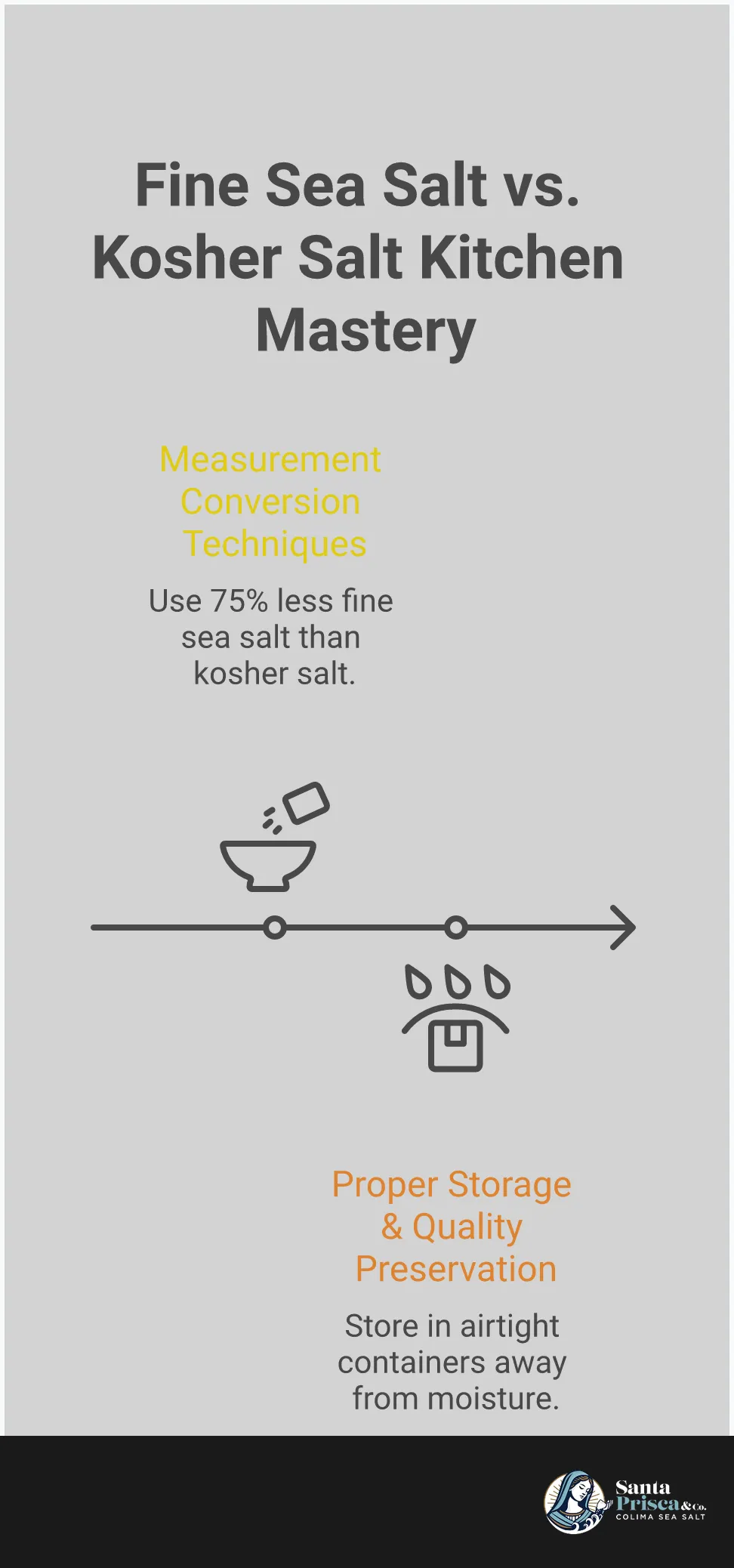
As a general guideline, if a recipe calls for table salt and you want to use a coarse kosher salt, you may need to use up to 50% more. Conversely, if a recipe specifies a certain kosher salt and you’re using a fine sea salt, you’ll want to start with less and add to taste. This simple guide to salt can help you make adjustments without over-salting your food.
When to Swap (and When Not To)
Knowing when to use each salt helps bring out the best in your ingredients. Kosher salt is excellent for seasoning during the cooking process—dissolving into pasta water, seasoning meats before searing, or mixing into doughs. Its clean flavor seasons food without overpowering it.
Fine sea salt, especially a hand-harvested variety like our Colima Sea Salt, truly shines as a finishing salt. A final sprinkle over a finished dish adds a delicate crunch and a burst of mineral depth that you can taste. Imagine it scattered over a ripe tomato salad, warm chocolate chip cookies, or a perfectly grilled steak right before serving. It’s that final touch that makes a meal memorable.
The "Pinch" Problem: Why Volume Matters
We’ve all seen recipes that call for a “pinch” of salt, but this simple instruction highlights why volume can be so tricky. A pinch of fine sea salt delivers a much more concentrated salinity than a pinch of coarse kosher salt. This is because the term “kosher salt” actually refers to the salt’s large flake structure, which was historically used for koshering meat, not that the salt itself is certified kosher.
Because the crystal sizes vary so much between brands and types, relying on volume measurements can lead to inconsistent results. Understanding this empowers you to trust your palate. Start with a little less than you think you need, taste, and adjust. This mindful approach to seasoning is what separates good cooks from great ones.
A Look at the Health and Nutrition Facts
When we choose ingredients, we’re making a choice for our bodies and our palates. Salt might seem like a simple pantry staple, but the subtle differences between types can have a real impact on your cooking and your wellness. Let’s look beyond the shaker and understand what truly sets these salts apart.
Is One Saltier Than the Other?
Have you ever followed a recipe perfectly, only to find your dish is far too salty? The culprit might be the type of salt you used. Here’s the secret: gram for gram, all salt has the same amount of sodium and the same level of saltiness. The difference comes down to volume.
Think of it like packing a jar with pebbles versus sand. The large, flaky crystals of kosher salt take up more space, leaving more air pockets. A teaspoon of fine grain sea salt, with its tiny, dense crystals, packs in much more actual salt. This is why many chefs prefer to measure salt by weight for consistency. If you’re measuring by the spoonful, remember that you’ll need less fine sea salt than coarse kosher salt to achieve the same flavor.
Beyond Sodium: Trace Minerals and Additives
At its core, salt is sodium chloride. But what’s left out—or left in—is what creates its unique character. Kosher salt is celebrated for its purity; it’s almost entirely sodium chloride, though some brands include anti-caking agents to keep it from clumping.
Unrefined sea salt, on the other hand, tells the story of its origin. As seawater evaporates, it leaves behind a beautiful mosaic of minerals. Our Colima Sea Salt, for example, retains trace amounts of magnesium, calcium, and potassium from its journey through volcanic earth. While these minerals are present in small quantities, they contribute to a more complex flavor and reflect a whole, untouched ingredient—something we believe is fundamental to mindful eating.
The Deal with Iodine
You’ve likely seen “iodized” on salt containers your whole life. Iodine is an essential nutrient for thyroid health, and fortifying table salt with it was a major public health success. However, it’s not something you’ll typically find in kosher or unrefined sea salts.
Does that mean you should be concerned? Not at all, as long as you eat a varied diet. Iodine is naturally present in many other foods, including fish, seaweed, dairy products, and eggs. Choosing an un-iodized salt is simply an invitation to source your nutrients from whole foods, allowing the salt’s natural flavor to shine without the slightly metallic taste that iodine can sometimes add. You can learn more about the role of salt and sodium from the Harvard T.H. Chan School of Public Health.
How to Keep Your Salt Fresh and Dry
When you bring a truly special ingredient into your kitchen, like a hand-harvested sea salt, caring for it becomes a small ritual. You’re not just storing a condiment; you’re preserving the work of artisans and the pure, mineral-rich gift of the earth. Proper storage ensures that every pinch delivers the crisp texture and burst of flavor you expect. It’s a simple act of intention that honors the journey from the salt flats of Colima to your table.
Simple Storage Tips
I love the feeling of a well-organized pantry, where every ingredient is given a proper home. For salt, this means creating a system that is both beautiful and practical. If you purchase a larger bag of our Colima Sea Salt, I recommend dividing it. Keep a small amount in a salt cellar or a lidded ceramic bowl by your stove for easy access during cooking.
Store the rest in a larger, well-sealed container in your pantry. This keeps the bulk of your salt protected from daily kitchen elements like steam and light, ensuring it stays perfectly fresh until you’re ready to refill your cellar. This simple step makes daily use more convenient and preserves the integrity of your supply.
Keeping Moisture Out
The greatest enemy of pure, unrefined sea salt is moisture. Humidity in the air can cause the delicate crystals to cling together, creating clumps that are difficult to work with. To prevent this, the key is to keep it dry in an airtight container. A glass jar with a tight-fitting lid or a dedicated pantry container works beautifully.
Find a home for your salt away from the stove, sink, or any other sources of steam. A cool, dark cupboard or pantry is the ideal environment. By protecting your salt from moisture, you ensure that each crystal remains distinct and ready to dissolve perfectly into a dish or provide that finishing crunch. It’s all about preserving that sun-dried, crisp flake texture we love so much.
Does Salt Go Bad?
Here is a wonderful truth about salt: it is an incredibly stable mineral. With proper storage, salt can last essentially forever. It doesn’t spoil or expire in the way that other foods do. This is why it has been used as a preservative for centuries—its very nature inhibits the growth of spoilage-causing microbes.
While the salt itself won't go bad, its quality can be affected by its environment. If left exposed, it can absorb moisture, leading to clumping, or even pick up strong odors from nearby spices. By storing it correctly, you are ensuring its texture and pure flavor remain unchanged. You can confidently stock your pantry, knowing this foundational ingredient will be ready for you whenever you need it.
Common Missteps to Avoid in the Kitchen
In our culinary journeys, we develop habits and rhythms that serve us well. But when it comes to an ingredient as fundamental as salt, a small shift in awareness can transform a good dish into a truly memorable one. It’s not about rigid rules, but about cooking with intention. Let’s walk through a few common missteps in the kitchen and explore how a little more mindfulness can deepen the flavor and connection we find in our food. By paying closer attention to the salt we choose, we honor both the ingredients and the people we nourish.
Thinking All Salt Tastes the Same
It’s easy to see salt as a simple, one-dimensional ingredient. But to believe all salt tastes the same is to miss a world of nuance. While the basic compound is sodium chloride, the journey from ocean to table imparts a unique character. Refined table salt offers a sharp, aggressive saltiness, while kosher salt is cleaner and less potent. A hand-harvested sea salt, like our Colima Sea Salt, carries the story of its origin. You’ll notice a gentler, more complex flavor—a subtle mineral depth that enhances food without overpowering it. The difference is in the experience, the way it lingers on the tongue and draws out the true essence of your ingredients.
Ignoring How It Dissolves
Have you ever followed a recipe perfectly, only to find it too salty or bland? The culprit might be the salt’s texture. A teaspoon of fine sea salt contains much more salt than a teaspoon of coarse, flaky kosher salt because the smaller crystals pack together more tightly. Because of these differences in crystal size and shape, different salts measure differently by volume. Ignoring how a salt dissolves and disperses can easily throw a dish off balance. Fine grains melt away instantly, ideal for soups and sauces, while larger flakes are perfect for finishing a dish, adding a final burst of flavor and a delicate crunch.
Not Reading the Recipe Closely
When a recipe developer specifies a certain type of salt, they’re often doing so with texture and volume in mind. Using fine sea salt when kosher salt is called for—without adjusting the amount—can quickly oversalt your meal. It’s always wise to honor the creator’s intention, at least the first time you make a dish. Think of it as a quiet conversation with the recipe. Once you understand the role the salt plays, you can begin to experiment with confidence. This small act of paying attention is a beautiful way to respect the process and ensure the final dish is balanced, beautiful, and exactly as you hoped it would be.
Finding the Right Salt for Your Pantry
Why We Love Hand-Harvested Colima Sea Salt
There’s something deeply grounding about using an ingredient that’s been touched only by the sun, the earth, and human hands. Hand-harvested sea salt begins as pure ocean water, left to dry in the sun until beautiful salt crystals form. We love using it as a finishing touch, where its crisp texture can truly shine.
A sprinkle of our Colima Sea Salt just before serving makes flavors come alive. The delicate, crunchy flake adds a final layer of texture to everything from roasted vegetables and grilled steak to a simple slice of avocado toast. It’s that little moment of intention that transforms a meal.
Thinking About Quality and Value
You might notice that artisanal sea salt often comes with a higher price tag than other salts, and there’s a meaningful story behind that. The cost reflects the patient, natural process and the place it comes from. It takes time and care to harvest salt by hand, honoring traditions passed down through generations.
When you choose a hand-harvested salt, you’re investing in a process that’s slower and more connected to the earth. You’re supporting the artisans who steward the salt flats and ensuring their craft continues. For us, that connection is what gives an ingredient its true value. You can explore our full collection of mindfully sourced products in our shop.
Making Your Choice with Confidence
Walking down the grocery aisle, you’ll see many different types of salt, and it can be hard to know which one is right for you. Kosher salt, for example, is prized for being pure sodium chloride, free from the additives or iodine often found in table salt. It’s a clean, reliable choice for everyday cooking.
Unrefined sea salt offers a different kind of purity—one that comes from being whole and untouched. While kosher salt is processed to remove minerals, our sea salt retains its natural trace minerals from the sea. This isn’t about a major nutritional shift; it’s about flavor and intention. Those minerals give the salt a more complex, nuanced taste and a connection to its origin. Choosing it is a simple way to embrace whole, natural ingredients in your kitchen.
Related Articles
- Colima Sea Salt Benefits: Flavor, Minerals & Wellness
- Sea Salt for Cooking: Types, Benefits, and How to Use It Like a Pro
Frequently Asked Questions
Is sea salt actually healthier than kosher salt? While one isn't dramatically "healthier" than the other, they offer different things. Think of it as choosing a whole, unrefined grain over a processed one. Unrefined sea salt retains trace minerals like magnesium and potassium from the ocean, which contribute to a more complex flavor. Kosher salt is refined to be almost pure sodium chloride, offering a clean, straightforward taste without those extra elements.
Can I really taste the difference between them? Absolutely. The best way to understand the difference is to do a simple taste test. Place a few flakes of kosher salt on your tongue, and you'll notice a sharp, direct saltiness. Now try a crystal of a quality sea salt. You’ll find the flavor is often gentler and more nuanced, with a subtle mineral depth that lingers. This complexity is what makes it so beautiful for finishing a dish.
If I can only have one salt in my kitchen, which should I choose? This really depends on your cooking style. If you need a reliable workhorse for seasoning pasta water, brining meats, and building flavor during the cooking process, kosher salt is a fantastic choice. However, if you love adding a final touch of texture and a burst of clean, mineral flavor to your food right before serving, a fine, hand-harvested sea salt is truly special and versatile enough for all your needs.
Why is hand-harvested sea salt more expensive? The price reflects the incredible amount of care and time that goes into the process. Unlike mass-produced salts, artisanal sea salt is harvested by hand in a slow, traditional method that relies on the sun and wind. You're not just paying for salt; you're supporting the artisans, preserving a craft, and investing in an ingredient that is pure, unrefined, and deeply connected to its origin.
Does "kosher" salt have anything to do with religious dietary laws? This is a common point of confusion! The name doesn't mean the salt itself is certified kosher, though many brands are. It's called "kosher salt" because its large, coarse flake structure was historically the perfect texture for the koshering process, which involves drawing moisture out of meat.