
A Guide to Coarse Salt Refill for Grinder
Written By Santa Prisca & Co Staff Last updated on
The salt you choose for your kitchen holds a story of its origin. It carries the essence of the sun, the sea, and the earth it came from. Yet, it’s an ingredient we often overlook, grabbing whatever is convenient. Choosing your next coarse salt refill for grinder is an invitation to be more intentional. It’s a chance to connect with the hands that harvested it and the traditions behind it. This simple decision can transform your cooking, infusing it with a mineral-rich, complex flavor that processed table salt simply cannot offer. Let’s explore the world of artisanal salts and find one that brings a meaningful story to your table.
Key Takeaways
- Choose coarse salt for superior flavor and texture: Grinding unrefined crystals creates a satisfying crunch and releases complex mineral notes, offering a depth that processed table salt lacks.
- Look for purity and origin when choosing a refill: The best salts for your grinder are unrefined and free of additives, carrying a unique mineral profile and story that comes directly from their source.
- Turn seasoning into a mindful ritual: Using a grinder with quality salt is a simple practice that connects you to your ingredients, adding a thoughtful finishing touch that brings your entire dish into harmony.
Why Your Grinder Deserves Coarse Salt
There’s something deeply satisfying about the twist of a salt grinder. That gentle crunch is the sound of flavor awakening, a small ritual that connects us more deeply to our food. But the real magic isn’t just in the motion; it’s in the salt you choose to fill it with. Using a coarse, unrefined sea salt transforms a simple seasoning into an intentional act of nourishment. It’s about more than just making food salty; it’s about adding texture, complexity, and a story to every dish you create. Your grinder is a gateway to a world of flavor, and it deserves a salt that reflects that.
For a Consistent, Satisfying Grind
The beauty of coarse salt lies in its structure. Those large, crystalline grains don’t just dissolve into oblivion. When you twist your grinder, they break apart into crisp, irregular flakes that cling to food, providing a gentle burst of salinity and a delightful texture. This control is essential in the kitchen. When you season meat, for instance, experts at McGill University explain that larger grains are better at drawing moisture to the surface, which helps form a beautiful crust. A fine, powdery salt simply can’t achieve this. Grinding your salt fresh gives you a consistent, satisfying texture that enhances everything from a simple salad to a slow-roasted meal.
Unlocking Deeper Flavor and Minerals
Coarse, unrefined sea salt is a world away from the one-note taste of processed table salt. Each crystal carries the mineral-rich essence of the waters it came from. Our own Colima Sea Salt, for example, is hand-harvested from ancient salt flats, giving it a clean, balanced flavor with no bitter aftertaste. This is because unrefined salts retain trace minerals like magnesium, potassium, and calcium, which contribute to a more complex and nuanced profile. As culinary guides point out, there are subtle flavor differences between salts from various regions. By choosing a high-quality coarse salt, you’re not just seasoning your food; you’re infusing it with character and a true taste of place.
A Guide to Coarse Salts for Your Grinder
Choosing a salt for your grinder is more than just a practical decision; it’s an invitation to connect more deeply with your food. The coarse crystals you select carry their own unique story, mineral profile, and texture, transforming the simple act of seasoning into a moment of intention. When you twist that grinder over a finished dish, you’re not just adding flavor, you’re adding the final touch that brings all the other ingredients into harmony. It’s a small ritual that makes a world of difference.
While the options can seem endless, understanding the character of each type of salt helps you find the perfect one to complement your cooking. From the sun-drenched flats where sea salt is born to ancient, mineral-rich deposits deep within the earth, each coarse salt offers a distinct experience. The right one won't just add saltiness; it will add a layer of flavor, a satisfying crunch, and a whisper of its origin story. Let’s explore some of the most common coarse salts you’ll find, from pure, artisanal sea salts to smoky, flavor-infused varieties, so you can fill your grinder with confidence and purpose.
Artisanal Sea Salts
Artisanal sea salts are born from a simple, beautiful partnership between sun and sea. They are created by evaporating seawater, a process that leaves behind pure salt crystals brimming with trace minerals. Unlike refined table salt, these salts are left in their natural state, which means you get to experience their unique texture and clean, bright flavor. Our own Colima Sea Salt is a perfect example, hand-harvested from ancient salt flats.
The larger, irregular crystals of a good sea salt are perfect for a grinder. They break down into satisfying flakes that dissolve beautifully on the palate. Because these larger crystals make more direct contact with your taste buds, you may find you need less salt to achieve the same depth of flavor, a gentle way to be more mindful of your sodium intake while savoring every bite.
Himalayan Pink Salt
You’ve likely seen this beautiful, rosy-hued salt everywhere. Himalayan pink salt is mined from ancient sea beds in the Punjab region of Pakistan, and its signature color comes from trace minerals like iron oxide. It’s a visually stunning salt that looks lovely in a clear grinder, adding a touch of warmth to your kitchen counter.
When it comes to taste, the differences between Himalayan pink salt and other high-quality sea salts can be quite subtle. While it has a gentle, mild flavor, its mineral notes are not always distinctly different from a pure white sea salt. A comprehensive guide to salt can help you compare the nuances. Ultimately, while its color is lovely, the harvesting method and purity of a salt often have a greater impact on its final flavor profile.
The Role of Kosher Salt
Kosher salt is a beloved workhorse in professional and home kitchens alike, and for good reason. Its name comes from its use in the koshering process for meat, not because the salt itself is necessarily kosher. The large, flaky crystals are ideal for drawing out moisture. This salt can be sourced from either mines or the sea and is valued for being additive-free, meaning no anti-caking agents.
Its texture is its main advantage. The coarse, light flakes are easy to pinch and sprinkle, giving you excellent control over seasoning. In a grinder, it produces a consistent, even flake. While it provides a clean, reliable saltiness, it generally lacks the complex mineral depth of a hand-harvested, unrefined sea salt. It’s a fantastic all-purpose salt, but for finishing a dish, you might reach for something with a bit more character.
Smoked and Infused Salts
For moments when you want to add an unexpected layer of flavor, smoked and infused salts are your creative allies. Smoked salts are made by slow-smoking coarse sea salt over aromatic woods like hickory, applewood, or mesquite. The result is a salt with a deep, savory, and smoky aroma that can give grilled flavor to vegetables, fish, or even cocktails without ever firing up the grill.
Infused salts offer endless possibilities. They are typically made by blending a quality sea salt with herbs, spices, citrus zest, or even chilies. A pinch of lemon-infused salt can brighten a simple salad dressing, while a rosemary-infused salt is beautiful on roasted potatoes. These salts are best used as finishing salts, ground over a dish just before serving to preserve their delicate aromas and add a final flourish of flavor.
How to Choose the Right Coarse Salt Refill
Choosing a salt for your grinder is a small act that can completely transform your cooking. It’s about more than just finding something to fill the space; it’s about selecting an ingredient that will bring texture, flavor, and a story to your table. The right coarse salt doesn’t just season your food, it connects you to the place it came from.
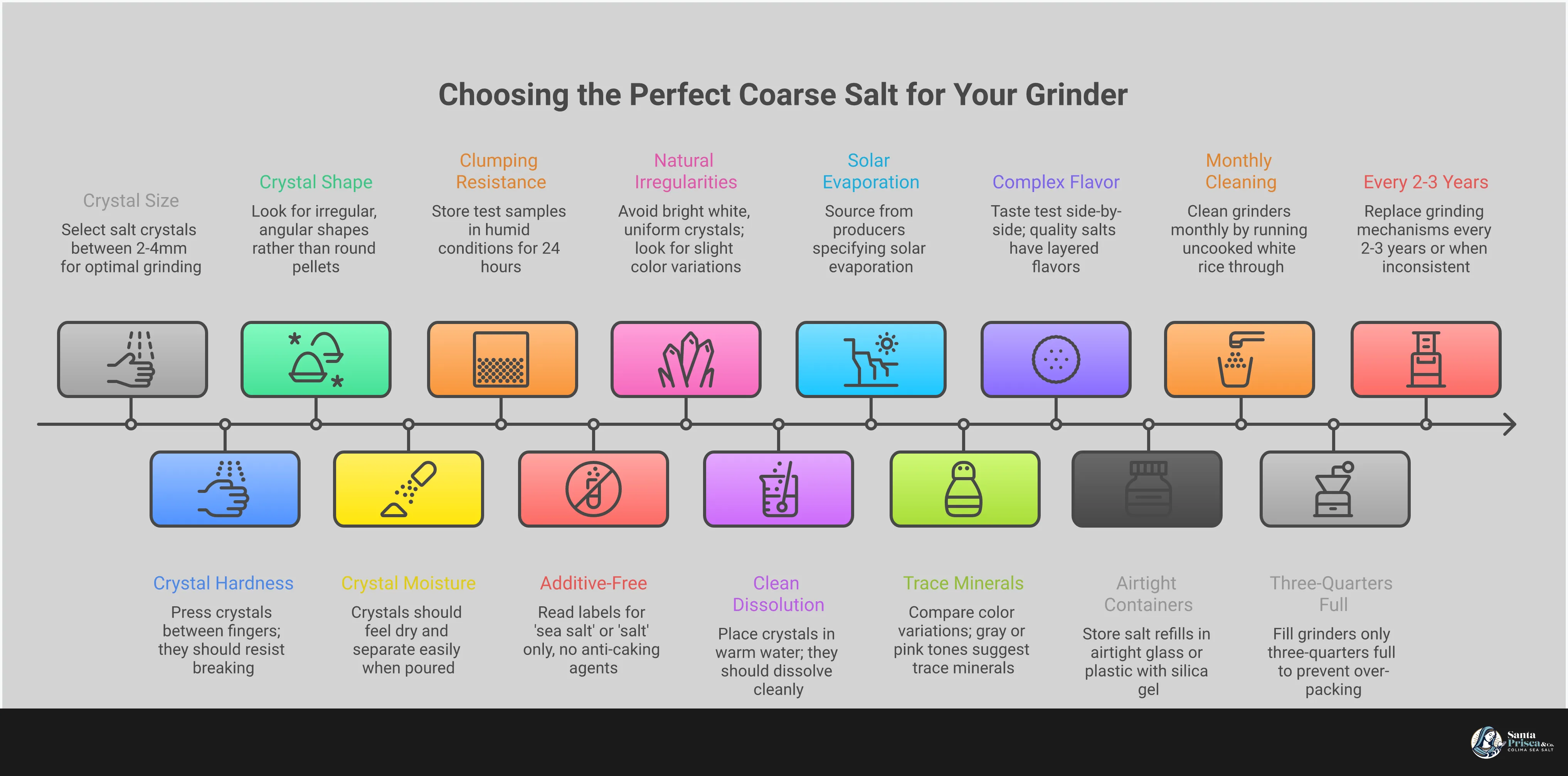
When you’re standing in the aisle or browsing online, it’s easy to feel overwhelmed by the options. But by focusing on a few key qualities, you can find a salt that not only works beautifully in your grinder but also aligns with your desire for pure, thoughtfully sourced ingredients. Think about the crystal’s structure, its purity, its connection to the earth, and even the subtle moisture it holds. Each of these details contributes to the final burst of flavor on your tongue. Let’s walk through what to look for, so you can choose with intention and confidence.
Grain Size and Hardness
The size and density of salt crystals are more important than you might think. For a grinder to work its magic, it needs salt with a substantial, hard grain that can stand up to the mechanism without turning to dust. Larger, more robust grains produce that satisfying crunch and a consistent, beautiful flake every time.
When seasoning meats, for example, a larger grain is ideal. It doesn't dissolve instantly, giving it time to draw moisture to the surface and create a perfect crust. A guide to different salts explains that this characteristic is key for cooking. Look for coarse crystals that feel solid and substantial, promising a texture that enhances every bite.
Purity: Look for Additive-Free Salt
The best salt is simply salt. Many commercial salts contain anti-caking agents and other additives to prevent clumping. While functional, these additions can introduce a subtle chemical bitterness and interfere with the salt’s true flavor.
Choosing an unrefined, additive-free salt ensures you’re getting a pure expression of its origin. It’s a commitment to clean eating and an uninterrupted taste experience. When you season your food with pure salt, you’re letting the ingredients speak for themselves. A guide to salt often recommends looking for options without chemical additives for this very reason. Your palate will thank you for it.
Moisture Content and Freshness
Authentic, unrefined sea salt often retains a trace amount of moisture from the ocean waters where it was born. This hint of brine is a beautiful sign of a natural product. However, for your grinder, you’ll want a salt that is dry enough to flow and grind smoothly.
Too much moisture can cause the salt to clump and clog the grinding mechanism. When you’re choosing a refill, look for salt that feels fresh and dry to the touch. This balance ensures an effortless grind and a perfect flurry of flakes with every twist. The right salt for your kitchen depends on finding this ideal texture for your tools.
Source and Mineral Profile
Every salt tells the story of its home. Whether it’s mined from ancient mountain ranges or harvested from sun-drenched coastal flats, its origin shapes its character. The unique geology of a place imparts a distinct mineral profile, which in turn creates a one-of-a-kind flavor.
For instance, some salts have a sharp, direct salinity, while others offer a more gentle, complex flavor that lingers. Our Colima Sea Salt is hand-harvested from flats naturally filtered by volcanic earth, giving it a rich mineral depth. Understanding the source of your salt allows you to choose a flavor profile that truly complements your cooking.
Finding a Salt You Can Trust
Choosing a salt for your kitchen is about more than just seasoning. It’s an invitation to connect with the earth, the hands that harvested it, and the traditions behind it. When you find a salt you can trust, you’re not just buying an ingredient; you’re bringing a story to your table. It’s about looking past the label to understand where your salt comes from, how it was gathered, and the care that went into its journey to you. This simple act of choosing consciously can transform your cooking from a daily task into a mindful ritual.
Why We Stand By Our Colima Sea Salt
We believe in a salt that tastes purely of its origin. Our Colima Sea Salt is hand-harvested from the pristine waters of Cuyutlán Lagoon, where ancient methods meet the natural cycle of the sun and earth. The salt is made by simply evaporating seawater, a process that preserves its incredible mineral complexity and gives it a clean, crisp flavor. Each coarse crystal carries the essence of the Pacific Ocean and the volcanic earth that filters it. This isn't just salt; it's a taste of place, a sun-dried crystal with a burst of mineral depth that brightens every dish it touches.
What to Look for in an Artisan Producer
When you’re searching for a quality salt, let curiosity be your guide. Ask where it comes from and how it’s made. The different sources of salt, whether it's mined from ancient mountains or harvested from living coastlines, tell you so much about its character. Look for producers who are transparent about their process, who honor traditional harvesting methods, and who work in harmony with their environment. An artisan producer doesn’t just sell a product; they share a piece of their heritage. Choosing them means you’re supporting a story of craftsmanship and sustainability.
Understanding Value Beyond the Price Tag
The true worth of a good salt is measured in flavor and feeling, not just dollars and cents. While many salts look similar, their impact on your food can be worlds apart. A high-quality, unrefined salt offers a nuanced flavor and texture that a processed table salt simply can’t replicate. Its culinary versatility means it can be the finishing touch that makes a dish sing or the foundational element that builds layers of flavor. Investing in a premium salt is an investment in your cooking, turning simple meals into moments of genuine pleasure and connection.
Where to Find High-Quality Coarse Salt
Once you decide to bring a high-quality coarse salt into your kitchen, the next step is knowing where to look. The search itself can be a beautiful part of the process, connecting you more deeply with the ingredients you use every day. It’s about finding a source you trust, one that values purity and craftsmanship as much as you do. Whether you prefer the ease of online shopping or the charm of a local market, there are wonderful options available that will lead you to a salt that truly resonates with your cooking.
From Reputable Online Retailers
The digital world has opened up a direct path to some of the finest salt producers on the planet. Many small, family-run operations and artisanal brands now offer their products online, allowing you to purchase directly from the source. This is often the best way to learn the story behind the salt and ensure you’re getting a truly authentic product. When browsing online, look for retailers who are transparent about their harvesting methods and origins. A truly great salt has nothing to hide. You can explore our own hand-harvested Colima Sea Salt to see what a difference mindful sourcing makes.
In Your Local Gourmet and Health Shops
There is a special kind of joy in wandering the aisles of a local gourmet or health food store. These shops are often carefully curated by owners who are passionate about quality ingredients. Here, you can hold a bag of salt in your hands, feel the texture of the crystals, and read the labels up close. Don’t be afraid to ask questions. The staff in these specialty stores are usually a wealth of knowledge and can guide you to a salt that fits your needs. It’s a wonderful way to support local businesses while discovering new treasures for your pantry and connecting with your community.
Sourcing in Bulk for Your Kitchen or Business
For the dedicated home cook or the professional chef, buying in bulk is both a practical and a sustainable choice. Purchasing a larger quantity of your favorite salt means you’ll always have it on hand for brining, finishing, and seasoning. It also reduces packaging waste, which is a simple way to make your kitchen a little more gentle on the earth. If you run a restaurant, café, or small food business, sourcing a high-quality salt can become a signature part of your flavor profile. We offer wholesale inquiries for those who want to share the unique taste of Colima salt with their own customers.
Understanding the Price of Premium Salt
When you stand in the aisle, it’s easy to wonder why one salt costs a few dollars while another is a considered purchase. The difference isn't just about a prettier package; it’s a reflection of the journey from the earth to your kitchen. A premium price tag often signifies a commitment to purity, traditional harvesting methods, and a mineral profile that simply can’t be found in refined, mass-produced salts. It speaks to the hands that harvested it, the sun that dried it, and the pristine environment that created it.
Think of it as an investment in flavor and wellness. You’re choosing a salt that has been carefully tended to, honoring the integrity of the ingredient and preserving the trace minerals that give it a complex, nuanced taste. When you choose an artisanal salt, you’re not just seasoning your food. You are connecting with a place, a tradition, and a more intentional way of nourishing yourself and your loved ones. It’s a small act of gratitude for the simple, powerful gifts from the earth, and a choice to bring that story to your own table.
How Quality and Origin Affect Price
While most salt is chemically sodium chloride, the small percentage that isn’t makes all the difference. Industrial table salt is often mined and heavily refined, stripping it of its natural minerals and adding anti-caking agents. In contrast, an artisanal sea salt like our Colima Sea Salt is a direct product of its environment, a true reflection of its origin.
Hand-harvested from the sun-drenched lagoons of Colima, Mexico, our salt is a testament to place. The process is slow and deliberate, allowing the sun and wind to naturally evaporate the water and form delicate, mineral-rich crystals. This method preserves the trace elements absorbed from the volcanic earth below, giving the salt its clean, balanced flavor. The cost reflects this patient, traditional craftsmanship and the unparalleled purity of the final product.
The Benefits of Buying in Bulk
Once you experience the difference a high-quality salt makes, it becomes an indispensable part of your kitchen. For those who cook with intention every day, buying in bulk is both a practical and economical choice. It ensures you always have your favorite seasoning on hand for everything from finishing a salad to brining a chicken, allowing you to seamlessly integrate its benefits into your daily rituals.
Purchasing larger quantities often reduces the cost per ounce, making a premium product more accessible for your household. It’s also a more sustainable option, minimizing packaging and reducing your environmental footprint. If you’re a home chef, baker, or small business owner who values exceptional ingredients, consider exploring our wholesale inquiries to keep your pantry stocked with the purity of Colima.
Tips for Smart Shopping
When choosing a salt, let purity and texture be your guides. Look for salts that are labeled "unrefined" and "additive-free." This ensures you’re getting a clean, natural product without the anti-caking agents or bleaching chemicals found in common table salt. The texture is just as important; a good coarse salt should have a satisfying, delicate crunch that dissolves cleanly, seasoning food more evenly.
Trust your palate. A quality sea salt shouldn’t just taste intensely salty; it should offer a more complex, almost sweet mineral depth that enhances the natural flavors of your ingredients. We invite you to explore our collection and find a salt that resonates with your cooking style. Investing in a versatile, high-quality coarse salt is one of the simplest ways to bring more intention and flavor to every meal you create.
The Difference Between Coarse Salt and Table Salt
Walking down the grocery aisle, you’ll see a dozen different kinds of salt. It’s easy to think they’re all the same, but the salt you choose can completely change the way your food tastes and feels. The familiar shaker of fine, white table salt is a world away from the crystalline flakes of a pure, unrefined coarse salt. The distinction isn't just about size; it’s about origin, processing, and the story each crystal tells.
Table salt is heavily processed. It’s mined from underground deposits, stripped of its natural minerals, and heated to extreme temperatures. Often, anti-caking agents and iodine are added back in. The result is a uniform, sharp saltiness that can easily overwhelm a dish. Coarse salt, especially artisanal sea salt, is a different story. It’s a direct reflection of its environment, carrying the subtle flavors of the ocean and earth it came from. This simple switch from a processed salt to a natural one is one of the most meaningful changes you can make in your kitchen.
For Superior Flavor and Texture
The most immediate difference you’ll notice is in the flavor and feel. Because coarse salt is less processed, it retains more of its natural minerals, which contribute to a more complex and gentle flavor. Instead of a harsh, chemical sting, you get a nuanced salinity that enhances the food it touches.
The larger crystals also create a beautiful texture. When you sprinkle coarse salt over a finished dish, each crystal offers a tiny, satisfying crunch and a bright burst of flavor. This is why chefs love it as a finishing salt on everything from salads and roasted vegetables to a perfectly seared steak or even a chocolate chip cookie.
Embracing Natural, Unrefined Minerals
Beyond flavor, the journey from source to kitchen is what truly sets these salts apart. Table salt is refined to be almost pure sodium chloride. In contrast, unrefined sea salts are minimally processed, allowing them to keep the trace minerals they absorbed from the ocean, like magnesium, potassium, and calcium.
These minerals are part of what gives a salt like our Colima Sea Salt its unique character and moist, crystalline structure. Choosing an unrefined salt means you’re seasoning your food with an ingredient that is whole and pure, free from the additives and anti-caking agents found in its processed counterpart. It’s a small act of intention that connects your cooking back to nature.
Its Versatility in the Kitchen
Chefs and home cooks alike appreciate the control and versatility that coarse salt offers. The larger grain size makes it easy to pinch and sprinkle, so you can see exactly how much you’re adding. This tactile connection to your ingredients helps you season more intuitively.
Coarse salt is a true kitchen workhorse. Its texture is perfect for creating a crust on meats before roasting or grilling. It dissolves beautifully in brines and stocks, infusing flavor deep into your food. And, as a finishing touch, it adds that final layer of texture and bright salinity that makes a dish feel complete. From preparation to plating, it’s an indispensable tool for intentional cooking.
Caring for Your Salt Grinder
Your salt grinder is a trusted kitchen companion, a simple tool that connects you to the ritual of seasoning your food with intention. Giving it a little care ensures it works beautifully for years, delivering that satisfying crunch of freshly ground salt with every twist. When you honor your tools, you honor the entire process of cooking, from sourcing ingredients to sharing a meal. A well-maintained grinder is a small but meaningful part of a mindful kitchen practice.
How to Clean and Prepare Your Grinder
Before you refill your grinder, it’s a good practice to give it a quick cleaning. This removes any old salt dust or oils, ensuring the flavor of your new salt shines through, pure and untainted. A simple way to do this is to empty any remaining salt and grind a small amount of uncooked white rice through it. The rice absorbs residual oils and dislodges any stubborn salt particles. Remember, for a salt mill to work correctly, the salt you put in needs to be firm and hard. These grinders are specifically designed to be used with coarse sea salt, whose texture is perfect for the grinding mechanism.
The Right Way to Fill It
When it’s time to refill, always choose a coarse, dry salt. Moisture is the enemy of a good salt grinder, leading to clogs and corrosion. The salt crystals should be large enough for the mechanism to grip and grind effectively. Our Colima Sea Salt is hand-harvested and sun-dried, giving it the ideal texture and low moisture content for any grinder. Simply open your mill, carefully pour the salt crystals in until it’s about three-quarters full to avoid over-packing, and secure the top. You’ll be rewarded with a smooth, consistent grind every time you reach for it.
Storing Your Salt for Lasting Freshness
Because natural, unrefined sea salt contains no chemical anti-caking agents, proper storage is key. Keep your salt in a dry, cool place away from humidity. If you notice your salt starting to clump, it’s actually a good sign; it means your salt is pure and free from additives. To preserve its texture and potent mineral profile, store your salt refill in an airtight container. Thoughtful pantry organization not only keeps your kitchen tidy but also protects the integrity of beautiful, whole ingredients. This simple step ensures every pinch you grind is as fresh and flavorful as the day it was harvested.
Related Articles
- The 6 Best Refillable Salt Grinders of 2026 – Santa Prisca & Co
- Sea Salt for Cooking: Types, Benefits, and How to Use It Like a Pro – Santa Prisca & Co
- What is Gourmet Sea Salt & How to Use It? – Santa Prisca & Co
Frequently Asked Questions
Can I use any type of coarse salt in my grinder? Not all coarse salts are created equal, especially when it comes to your grinder. The key is to choose a salt that is both hard and dry. Some natural sea salts retain a bit of moisture, which is a beautiful sign of their purity, but too much can cause clumping and clog the grinding mechanism. Look for a salt with a solid, crystalline structure that will break into satisfying flakes rather than turning to dust.
What's the real difference between a white sea salt like Colima and Himalayan pink salt? While Himalayan salt is known for its beautiful rosy color from trace minerals like iron, the flavor difference can be quite subtle compared to a high-quality white sea salt. The most important factors are how the salt is harvested and its origin. A hand-harvested salt like our Colima Sea Salt, which is naturally filtered through volcanic earth, offers a clean, balanced flavor profile that truly reflects its unique source. It’s less about color and more about the purity and character of the salt itself.
Is unrefined sea salt actually better for you than table salt? The main distinction lies in the processing. Table salt is heavily refined, stripping it of its natural trace minerals and often including anti-caking agents to prevent clumping. Unrefined sea salt is left in its whole, natural state. This means you get the benefit of trace minerals like magnesium and potassium, and you avoid consuming unnecessary additives. It’s a simple way to choose a purer, more natural ingredient for your kitchen.
Why does my grinder sometimes get stuck or clogged? A clogged grinder is almost always caused by moisture. This can happen if you use a salt with a high moisture content or if you store your grinder in a humid environment, like right next to the stove. To keep it grinding smoothly, always fill it with a very dry coarse salt and store it in a cool, dry spot. If it does get clogged, grinding a little uncooked white rice can help absorb moisture and clear out any residue.
I already have kosher salt. Can I just use that in my grinder? You certainly can. Kosher salt has a great texture for grinding and is valued for being free of additives. It provides a clean, reliable saltiness that works well for general seasoning. However, it typically lacks the complex mineral depth of a hand-harvested, unrefined sea salt. For finishing a dish where you want the salt to add its own unique character and a more nuanced flavor, an artisanal sea salt is a beautiful choice.